Anne Frank House tickets sold out: how to replan your Amsterdam day

When Anne Frank House tickets are unavailable, separate two questions: whether another suitable date is possible, and how to use the time now open in your itinerary. You do not need to give the day to waiting outside or an intermediary’s promise. Check the official calendar, decide and make a workable new plan. Anne Frank’s story remains accessible through the museum’s own materials, while another city visit can have meaning in its own right. It will be a different experience, with time for attention and rest rather than constant refreshing of a ticket page.
Below are practical steps and an example from 10:00 to 14:00 for someone already near Prinsengracht: a brief exterior stop → walk to Plantage → the Dutch Resistance Museum → your own lunch. Anne Frank House admission is not included. Check the Resistance Museum’s calendar and entry beforehand; availability elsewhere is not guaranteed by one museum being sold out. If still at your accommodation, you need not travel to the house first. Go directly to the chosen museum and give the saved time to visiting and rest. Return travel is additional.
Check the date and the actual admission rules
Anne Frank House sells tickets only through its official website, for a specific time. Tickets are not sold at the door. If a released date has no availability, the museum considers it sold out; there is no waiting list. This differs from a date not yet released. Check the calendar’s booking horizon before concluding your entire trip is unavailable. If planning well ahead, the issue may be that sales have not reached your date rather than that every place has already gone. Distinguishing those situations is the useful first step.
Try RoadMe for a complete personal route or trip plan shaped around your interests and pace. The app makes it much more convenient and effective to arrange available visits, walks and rest as one programme for your stay.
The museum releases tickets on Tuesdays at 10:00 Amsterdam local time for visits six weeks later. When planning from another time zone, use the city’s local clock and the current calendar. This is a release rule, not a promise of availability at any time afterwards. If your preferred released date is sold out, check other dates during your stay on the official site. Existing commitments matter too: an available slot must fit the actual journey, without requiring an unrealistic rush between incompatible arrangements elsewhere in the city.
A commercial listing called an “Anne Frank tour” may offer a different programme. The museum explicitly states that commercial tours about Anne Frank do not provide admission to Anne Frank House. Read what is included: a street-based account and entry to the museum are different services. An ambiguous name is not a confirmed ticket. You may choose a walking tour for its own content, but that is a separate decision. This article promises no hidden allocation, group-entry workaround or opportunity to negotiate admission at the door. Replanning can begin with genuinely available choices.
Identify what mattered about the original visit
Perhaps you wanted the specific place, a better understanding of occupation, or a connection between the diary and the city. Those interests suggest different continuations. For Anne Frank and the hiding place specifically, official materials preserve the subject when physical entry is unavailable. For broader historical context, consider the Resistance Museum. If ticket disappointment has already exhausted your attention, a walk or change of subject is reasonable. You do not have to find an institution with a similar name merely to fill a gap in the day’s list.
Anne Frank went into hiding from Nazi persecution in the annex of her father’s business premises in 1942. In August 1944, the people hiding there were discovered and arrested. Her diary is connected with that life in hiding. A few facts prevent the place becoming only a popular calendar reservation. Another exhibition can provide context, but does not reproduce this particular house or personal story. Treat the revised plan as another way to continue learning, while preserving differences between testimony, place and a broader account of the period.
10:00: a brief exterior stop if already nearby
Allow about ten minutes in public space. The museum occupies Prinsengracht 263–267, while its entrance is around the corner at Westermarkt 20. Avoid joining a queue hoping to buy at the door, and leave room for visitors arriving at their booked time. The canal façade does not reveal the hiding place as an interior visit does. There is no promise of looking into it from the street. An exterior stop connects the name with the city, without becoming a free equivalent of admission. Move on if public space is limited.
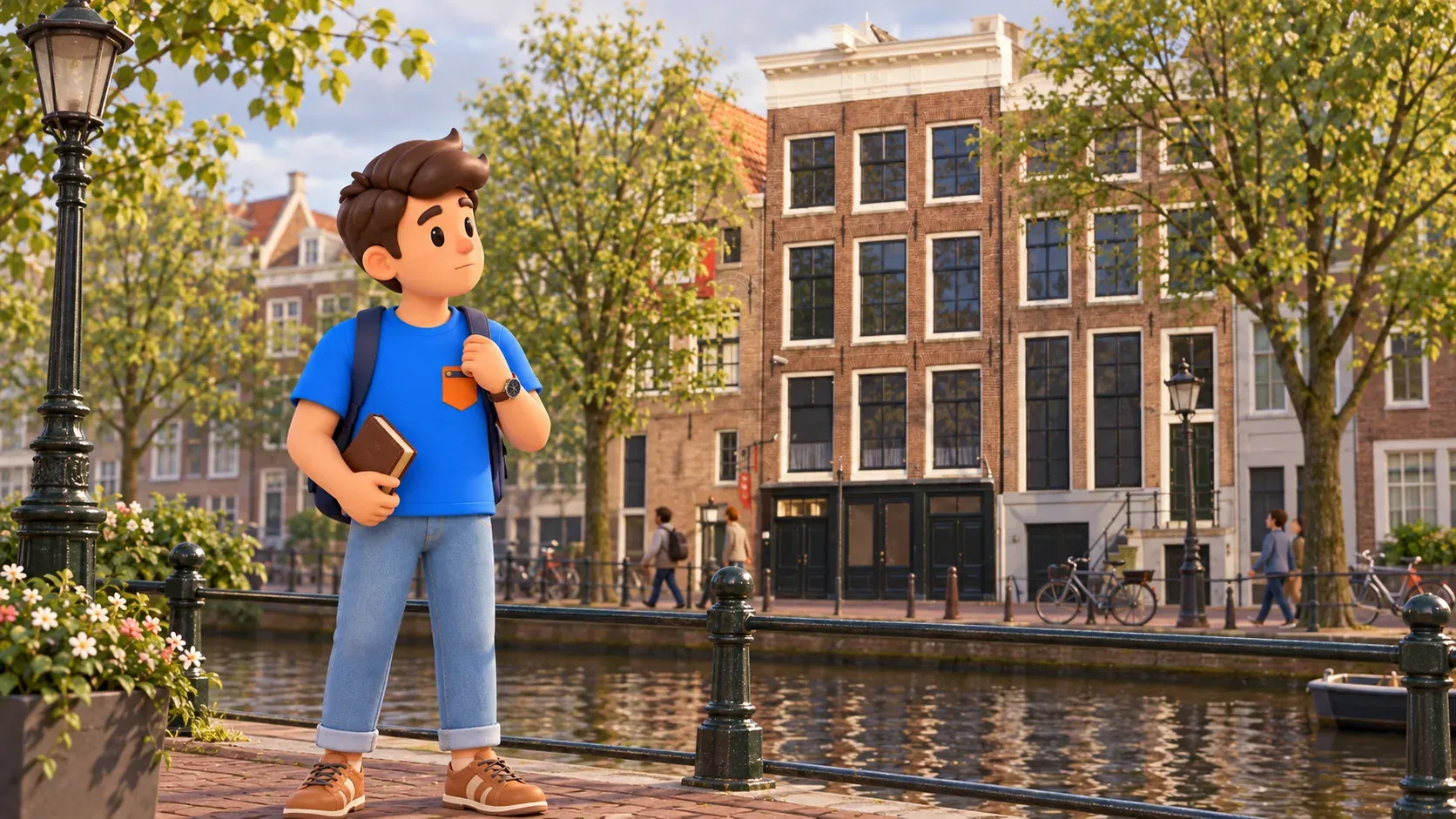
Choose quiet observation rather than a staged photo session. There is no need to prove through a photograph that the missed interior visit happened after all. With a child, explain briefly why the house matters and why you are not entering today. Ticket availability does not determine the value of its history. You can explore official materials together later at a suitable pace. If you have read the diary, remember one question you hoped to bring; it can guide later reading even when the day’s route has changed.
10:10: walk to Plantage without collecting more stops
Allow fifty-five minutes to the Resistance Museum, arriving around 11:05. A current walking calculation gives about 2.6 kilometres; that is a map estimate, not our own on-location measurement. Our allowance includes orientation and a gentler pace. Follow current public crossings and allow for street works. This is a connection across neighbourhoods, not the next door nearby. Avoid adding every memorial and museum along the way: the main new visit already needs your attention. Adjust arrival for your speed or a detour, keeping enough time before closing.
If walking does not suit, check a current public-transport connection and its duration for your date. The example is not tied to a particular tram number or guaranteed interval. Rebuild timings around your actual arrival. Before setting out, the useful action is confirming that the chosen museum is open and suitable admission available. Do not repeat the disappointment at a second door. In poor weather, decide on lunch beforehand too, rather than leaving every practical choice until you arrive tired and wet after a longer transfer than expected.
11:05: prepare for an independent museum visit
The Dutch Resistance Museum is at Plantage Kerklaan 61. Ordinary hours are daily 10:00–17:00, with closure on 1 January, 27 April and 25 December. Check current ticket conditions too. Our schedule gives ten minutes until 11:15 for entry and preparation. This is an allowance, not guaranteed service time or absence of queues. If more is needed, move subsequent blocks. For particular mobility, sensory or companion requirements, discuss facilities with the museum before travelling. Proximity to other attractions does not establish what arrangements are appropriate for your own visit.
Admission is paid; your lunch and travel are separate. Do not assume another museum’s ticket or concession applies here. Select the correct category and conditions for this institution. Once inside, choose a few questions: what happened to daily life, what decisions did people face, and how do personal accounts relate to the wider story? That gives direction without requiring immediate coverage of every section. You are giving attention to another substantial account, which deserves time for its own content rather than merely compensating for a missing reservation elsewhere.
11:15–13:15: another museum and a broader historical scale
The permanent exhibition addresses the Netherlands during the Second World War and civilian responses to Nazi occupation. Individual circumstances and choices matter here. This is a broader context than one hiding place. Allow about two hours, our estimate for an independent visit rather than a museum limit or a promise of seeing everything. Stay longer by reducing optional plans afterwards. If attention finishes sooner, ending after several carefully considered accounts is reasonable. A significant subject does not become clearer simply through increasing the number of rooms passed through.
Avoid searching for a direct equivalent to Anne Frank’s diary in every section. Notice where circumstances connect and where different people and decisions are involved. Individual lives cannot all be reduced to a familiar biography. Give explanations time and avoid conclusions from a single object. With companions, ask what you understood here for the first time. The question does not require identical emotional responses.
For a separate day involving several places of remembrance, use the route with memorials and the Resistance Museum. It is not automatically added after this visit. Today’s practical aim is rebuilding an available block while preserving historical interest. A larger programme needs its own time and energy. If companions want a lighter remainder, discuss that outside.
13:15: lunch and an unhurried finish
Keep forty-five minutes, 13:15–14:00, for your own lunch and rest near the finish. Select somewhere suitable beforehand; no table or serving speed is promised. Extend the block if a full meal needs longer. Return travel and further journeys are additional. The day can finish here or continue after a real pause with another interest. On a separate date, for example, choose one art museum according to your interests. That is a different kind of visit, not a claim that art substitutes for Anne Frank’s personal history.
With RoadMe, organising the whole trip around your interests and comfortable pace becomes much easier. Try a personal plan in the app to distribute substantial visits and rest across your days, with a considered continuation and enough time for what matters.
Over lunch, one thought or a period of quiet is enough. You need not produce a final opinion about everything immediately. A calmer revised day is a useful planning result, not a reason to rank historical places against one another. Each has its own role. Note a question you want to revisit and preserve time for it later.
Continue with official materials
Anne Frank House has an official Online and 3D tours section containing digital projects, material about the Annex and online visit formats. Choose a suitable option and check language, technical requirements and conditions: these products work differently, and some involve separate booking. This is not a claim that the entire section is a free substitute for admission. It is an independent learning opportunity at your accommodation or after the trip. Give reading and viewing quiet time rather than trying to process substantial historical material on a screen between busy streets.

A missing ticket changes access to one place, without ending your interest in history or requiring the rest of the day to become calendar refreshing. Check sales, choose a real alternative and preserve differences between institutions and formats. In our example, a short exterior stop, transfer, one museum and lunch take around four hours. Adapt it to actual availability and your energy. The useful change is moving from waiting for an unavailable entrance to a clear day with time for both attention and rest.