What to Check in Your Hotel Room After Check-In

Before unpacking, compare the room with your booking and check the door, bed, bathroom and amenities you need. Report visible damage or significant problems promptly, keeping photographs and the property's response. This makes it easier to agree on a solution before your first outing or night.
The checklist applies to hotels and short-stay apartments. It helps identify obvious issues; it is not a building inspection or a guarantee that the room has no hidden defects.
Compare the room with your booking and check the door
Open your booking confirmation. Check the room category, bed arrangement, private or shared bathroom and any essential included features. A confirmed separate bedroom or specified view should be assessed against the actual offer.
Different furniture colours do not necessarily mean the room is wrong. A shared bathroom instead of a booked private one, however, is a clear discrepancy to report.
Separate confirmed inclusions from requests. Asking for a high floor, adjoining rooms or early access does not establish that the property agreed to provide them.
Check that the entrance door closes and locks normally, the key or card works and the provided internal lock operates. Check accessible window and balcony locks without forcing them or taking risks. If the entrance cannot be secured, speak to the property before settling in.
Try essential facilities using their normal controls
Start with the facilities that affect your stay most. Test them through ordinary guest controls rather than opening equipment or attempting repairs.
| Area | A practical check | What to report |
|---|---|---|
| Water and drainage | Briefly run the tap; check temperature adjustment and drainage | No hot water, blocked drainage or a leak |
| Bathroom | Look at the shower, toilet and floor; check the flush | Soiling, a fault or water escaping onto the floor |
| Lighting and power | Switch on essential lights; use only visibly undamaged outlets | Failed lighting or a damaged outlet |
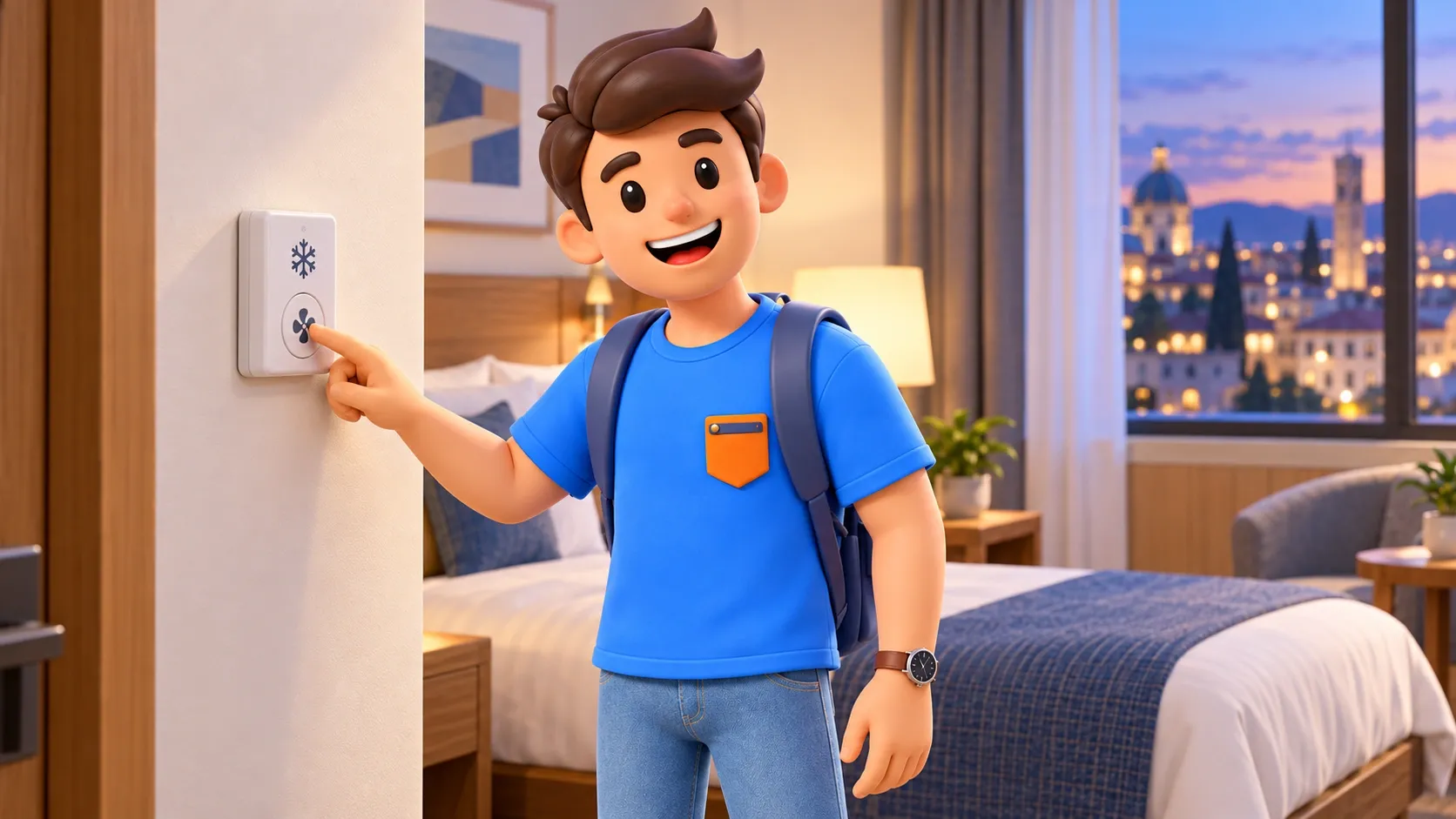
| Heating or cooling | Follow the controls and assess the result after starting it | No response, unusual noise or a burning smell |
| Internet | Use the network confirmed by the property and open a needed service | Failed access or unusable connectivity |
| Booked amenities | Check the features important to your reservation | A missing fridge, workspace or other confirmed facility |
Some rooms require a key card in a power holder or a closed balcony door for certain systems to operate. Ask for instructions if the controls are unclear. A running fan does not prove that the room is cooling.
For a work stay, try the connection with the service you need. Seeing a Wi-Fi symbol is different from being able to join your meeting or access your work system.
While you have a working internet connection, you can download your destination in RoadMe. Its maps and navigation are available offline after downloading, so prepare them before your first outing.
Stop using equipment that sparks, has visible electrical damage or smells as though it is burning. Report it rather than repeatedly testing it for evidence.
Look at bedding, cleanliness and luggage storage
Check sheets, pillows, towels and the surfaces you expect to use. Look at the bathroom and visible areas around the bed before spreading out your belongings.
Report stained bedding or an inadequately cleaned bathroom before using them. If there is a strong tobacco, damp or sewage smell, ask the property to investigate rather than treating air freshener as a complete solution.
Close the window and listen for noise from outside, the corridor and room equipment. Check that the curtains close sufficiently for sleep and privacy. A quiet afternoon does not guarantee a quiet night, but report an existing problem before bedtime.
Inspect a luggage rack before placing your suitcase on it, and keep luggage away from the bed. Look at the mattress and headboard for insects or suspicious signs. If you notice something concerning, keep belongings packed and notify the property.
Do not attempt to treat a hotel room with pesticides yourself. A brief visual check cannot rule out pests, and a single mark is not enough to identify an infestation. The next step is an assessment by the property.
Learn the exit route and how to request help
Read the evacuation plan and find the nearest emergency exits and stairs. US fire-safety guidance recommends identifying the two closest exits and counting the doors between your room and them; this can help you recognise the route in poor visibility.
Check where the emergency information is displayed and ask staff about an unclear or obstructed route. Do not cover detectors, remove them or operate alarm controls as a casual test. Report a visible fault or warning signal.
Establish how to contact reception from the room and what happens outside its staffed hours. For a short-stay apartment, confirm the responsible contact for access and maintenance problems.
If you see smoke, fire or another clear danger, stop the inspection and follow local emergency instructions. Do not remain in danger to collect photographs.
Record existing damage and clarify chargeable items
For an obvious defect, take an overview photograph and a closer image of the affected detail. Examples include a cracked fixture, stained furniture or a damaged cupboard. Keep other guests and personal documents out of the images.
Send the information through the agreed contact channel and request acknowledgement. A photograph alone does not show that the property received your report.
If a security deposit applies, check how the property records the initial condition. Images and messages help preserve information, but they do not guarantee repayment. See the guide to accommodation deposits and extra charges for the payment side.
Clarify minibar prices and other chargeable items before using them. A bottle of water being present in the room does not establish that it is complimentary.
Ask for a solution proportionate to the problem
Contact reception or the responsible property representative promptly. Describe the fault, how it affects your stay and the outcome you need.
| Issue | A useful request |
|---|---|
| Missing towel or a failed non-essential light | Supply the item or fix the fault |
| Dirty bedding, a significant odour or an essential facility not working | Cleaning, replacement or a suitable room change with a clear timeframe |
| A door that will not lock or an obvious hazard | Immediate assistance rather than waiting for routine maintenance |
| A room that differs from confirmed booking conditions | Provide the booked arrangement and record the discrepancy |
For example: “The shower is not draining. I reported it immediately after arrival and have attached photographs. Please confirm when it can be fixed or offer another room matching my booking.”
If you depend on a particular facility, explain why timing matters. A failed connection is more urgent when you have a scheduled work call than when you only want to browse later.
Record the proposed solution and timing. Follow up an oral agreement with a short written message. If you booked through a platform and the property is not addressing a significant issue, use the platform's official support channel and check its reporting requirements.
Keep the booking reference, evidence, time of your first report and the property's response together. Do not assume a refund or replacement accommodation is automatic. Outcomes depend on the issue, applicable rules and booking terms.
If you decide to leave, try to agree on the change or cancellation process with the property and platform where circumstances allow. Keep a record rather than treating departure itself as confirmation of a refund.
Repeat key checks after a room change
A replacement room needs its own basic inspection. Confirm the bed arrangement, door, bathroom and essential facilities rather than assuming it resolves every issue from the first room.
Before heading out, take your key and save the property's contact details. Confirm late access arrangements, and agree on staff entry if maintenance will happen while you are away.
Once the room is checked and you are ready to explore, you can try RoadMe for a short two-hour route from your current location. Use it for a first look around the neighbourhood after check-in.
You are ready to settle in when the room meets the important confirmed conditions, the facilities you need work, and any remaining issues are documented with a clear agreed next step.