Swiss Travel Pass or Half Fare Card: compare coverage and total cost

The Swiss Travel Pass is worth comparing when you expect frequent travel on its included network and will use its extra benefits during the pass’s valid days. The Swiss Half Fare Card suits a different calculation: pay for the card, then buy the eligible journeys at the reduced price. Neither is automatically the cheapest option for a holiday of a particular length.
Start with the trips and visits you genuinely want. Compare the full cost of ordinary tickets, the Swiss Half Fare Card plus discounted tickets, and the Swiss Travel Pass plus anything it does not cover. Keep the same dates, class and practical requirements in all three columns. A pass that looks cheaper after adding unwanted excursions is not saving money on your original holiday.
Understand the three products before comparing prices
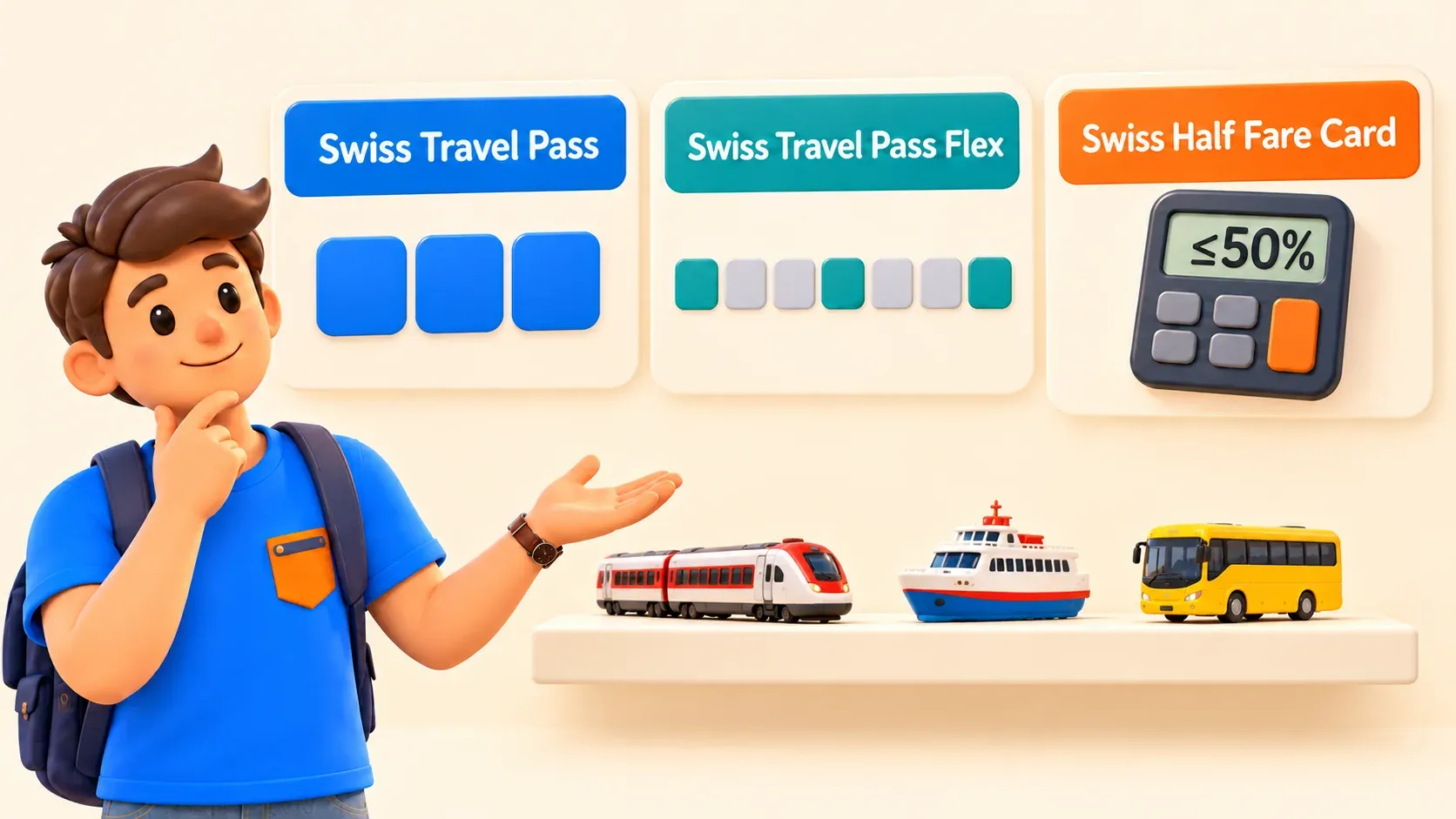
The Swiss Travel Pass covers eligible travel during a consecutive period. The Flex version gives a chosen number of travel days within one month. The Swiss Half Fare Card provides reduced-price ticket entitlement for one month; it is not itself a ticket for an ordinary journey. These tourist products are for people permanently resident outside Switzerland and Liechtenstein, rather than for one particular nationality.
Planning in RoadMe is more convenient than collecting disconnected ideas: the app develops a personal trip plan around your interests, dates and pace. Try deciding what you actually want to explore before choosing a transport pass, so the ticket supports your holiday.
| Product | How it works | Main calculation |
|---|---|---|
| Swiss Travel Pass | Included travel on consecutive valid days | Pass price plus excluded services and supplements |
| Swiss Travel Pass Flex | Included travel on activated days within one month | Pass price, extras and travel on inactive days |
| Swiss Half Fare Card | Buy eligible tickets at the reduced fare for one month | Card price plus every ticket and applicable extra |
Do not confuse the tourist Swiss Half Fare Card with the annual Half Fare Travelcard, often called Halbtax. They have different duration and purchasing conditions. A cheaper-looking annual loyalty price is not the tourist card’s price. Likewise, SwissPass is the name of a separate public-transport customer system; it is not simply a shorter spelling of Swiss Travel Pass.
The word “unlimited” still has boundaries: the covered network, the correct class, the valid day and any service-specific booking requirement. Checking those four points is more useful than assuming every train or mountain lift in Switzerland is included. The name of a destination alone does not tell you whether the final ascent is fully covered, discounted or outside the product.
What the Swiss Travel Pass includes, and where to check
The pass covers trains, buses and boats within its area of validity, along with participating urban transport. Some mountain excursions are included; other mountain journeys receive a reduction rather than free travel. Use the current validity map and the operator’s page for the exact connection. On a multi-stage excursion, check each section rather than assigning one answer to the whole mountain.
Rigi, Stanserhorn and Stoos are among the included mountain excursions named by the official tourist-pass information. This does not make every nearby lift or optional activity free. Compare the particular ascent, descent and operating season you want. A pass entitlement cannot make a lift run during maintenance or create visibility on a cloudy day.
Participating museums provide another possible benefit, but only count visits you would actually make. Confirm the museum, exhibition and admission conditions before entering a full ticket value into your comparison. “Museum included” is not a promise that every museum in the country, every special exhibition or every paid activity inside a museum is covered.
A scenic train can combine a covered transport fare with a separately priced reservation or supplement. Do not buy an additional full rail ticket when only the required extra is missing, but do not board a reservation-required service with the pass alone. Confirm availability for the actual departure before treating it as a settled part of your holiday.
What the Half Fare Card changes when buying tickets
The Swiss Half Fare Card reduces eligible ticket prices, often by half, and is valid for one month. Some short-distance journeys or special products have a smaller reduction because of their fare rules. Read the price for the actual eligible ticket rather than dividing every amount you find online by two.
The practical difference is that you still obtain the journey ticket. At inspection, the discounted ticket, valid discount entitlement and required original passport or official identity card belong together. Displaying the card alone does not replace the ticket. A photograph of the identity document is not a substitute for the original required by the tourist-product conditions.
Set the correct discount when comparing prices in the booking system. A search result may already assume a half-fare entitlement; the headline amount is not necessarily the full fare. Record whether each price is full or discounted, the class, date and fare conditions. Otherwise, it is easy to compare a discounted ticket against a full-price pass and draw the wrong conclusion.
A discounted supersaver ticket and a flexible ordinary ticket are different offers even when both are available with the card. Look at the train restriction and refund conditions before using the lowest amount in your calculation. If your plans require flexibility, compare flexible products; if you accept a fixed departure, keep that limitation visible.
Use a simple cost sheet instead of a universal rule
Make one row for each journey or paid visit. For transport, record the date, stations, class, suitable departure, ordinary fare, reduced fare and the coverage under the pass. For a museum or mountain excursion, record the actual admission or route product. Add any reservation, supplement or booking fee only where it applies.
| Column | What to add | What must not disappear |
|---|---|---|
| Separate tickets | Tickets and visits you would buy without a tourist pass | Fare restrictions and necessary reservations |
| Half Fare Card | Card plus actual reduced tickets and other admission | Services without a reduction and any extra charges |
| Swiss Travel Pass | Pass plus uncovered travel, discounted mountain tickets and extras | Inactive or out-of-validity days and reservations |
Use the same trips in each column. If you add an optional boat ride only because a pass includes it, mark it as an optional benefit, not as money saved on a ticket you intended to buy. You may value spontaneity, but that is a separate reason to choose the pass and should not inflate a claimed cash saving.
Compare the final purchase total in the currency charged. Some sellers display a different currency or add conditions at checkout. Check payment compatibility and refund terms before purchasing. Your bank’s conversion and any fees can differ from a reference exchange rate. Saving a quoted price without the product conditions is not enough to reproduce the comparison later.
The method also applies to international rail passes, though the products have different coverage. Our article on comparing a rail pass with separate tickets after reservations explains why the full cost matters. Do not transfer its European network rules to the Swiss tourist products.
A transparent comparison using the 2026 starting prices
For an adult aged 25 or over travelling in second class, the ordinary three-day Swiss Travel Pass costs CHF 254 in 2026. The three-days-in-one-month Swiss Travel Pass Flex costs CHF 289. The tourist Swiss Half Fare Card costs CHF 150 for one month. These are different products with different time patterns, not three prices for the same entitlement.
For a deliberately limited comparison, suppose your desired travel falls on three consecutive days and every transport segment is fully included in the ordinary pass. Set aside museums, mountain reductions and unequal extras for the moment. The Half Fare option is CHF 150 plus the sum of the actual reduced tickets; the pass is CHF 254. The difference is CHF 104.
If those reduced tickets total less than CHF 104, the Half Fare Card plus tickets costs less in that limited comparison. If they total more, the pass costs less. This is arithmetic from the verified product prices, not a claim about any particular route or a promise of savings. At equality, compare flexibility and convenience rather than inventing a price advantage.
Now restore the parts you set aside. Add the actual museum charges or reductions, mountain tickets and unequal reservation costs to the relevant column. If some travel is outside the pass’s covered days or network, add it too. The simple threshold no longer decides the whole result once the conditions differ; the complete sheet does.
For another duration or class, repeat the calculation with its actual price. The example uses the 2026 tariff checked in October; recalculate for a later tariff.
Consecutive days or Flex: match the calendar
The ordinary pass is sold for 3, 4, 6, 8 or 15 consecutive days; Flex uses the corresponding number of selected days within one month. A quiet day between longer journeys still consumes a day of a consecutive pass’s validity. Flex can avoid spending an included day on that gap, but has a different purchase price.
Flex benefits apply on activated travel days. An inactive day is not automatically a half-fare day, and museum admission does not remain included for the whole month. If you want to use a benefit during a quiet museum day, consider whether activating a day for it makes sense compared with paying for the visit separately.
Activate the Flex day before the first journey or relevant use, following the issued instructions. The purchase receipt is not itself the activated day ticket. Keep the correct travel document available, rather than assuming a booking confirmation on your phone proves that today has been selected.
A travel day is not a rolling 24-hour period beginning at your first train. Under the current tariff, a Flex day runs from midnight on the selected date until 05:00 the following morning. A late first departure does not shift that window into the next afternoon. Check a night connection against the actual validity and do not apply another country’s rail-pass timing rule.
For a longer holiday with only occasional journeys, compare the monthly Half Fare Card against the Flex total plus travel on inactive days. For several consecutive days of substantial covered travel, compare the ordinary pass. The number of hotel nights alone cannot decide between them: calendar pattern and the trips you will take are separate inputs.
Children, youth fares and class can change the result
Young travellers under 25 should compare the relevant Swiss Travel Pass Youth price rather than the adult amount used in the example. For children aged 6 and under 16, the complimentary Swiss Family Card can provide free accompanied travel under its conditions when a parent holds the qualifying tourist product. Add eligible children during purchase and confirm the issued family documentation.
Do not assume every child travelling with any adult qualifies on that basis. The accompanying relationship and product conditions matter. Check the actual arrangement for your family, including any special service charges or reservations. Compare the household total instead of multiplying the adult example by the number of people.
Keep the class consistent. A second-class pass does not automatically authorise first-class seating because a carriage is quieter. Check and buy an applicable upgrade before using it. With a Half Fare Card, the discount entitlement can apply to eligible first- and second-class tickets, but you still need the ticket for the class used.
RoadMe makes it easier to develop a personal plan that balances your interests with the pace of the whole group. Try deciding which days deserve a longer excursion and which should stay relaxed, then choose the pass around that plan rather than adding journeys to justify it.
Check the issued documents before travelling
Confirm names, start date, duration, class and the selected product before payment. Use the residence conditions honestly; speaking a language or holding a particular passport does not establish permanent residence. Check the seller’s cancellation process and the deadline that applies to the actual ticket instead of assuming all online purchases have identical refund rules.
How a ticket appears in SBB Mobile depends on the product and purchase method. SBB describes app display for eligible tourist products bought while signed in, while Flex has its own process. Keep the delivered ticket and instructions accessible, with an offline or printed backup where appropriate. A missing app tile does not mean you should buy the product again.
For each journey, check the station, destination, class and any compulsory reservation. Consult the current operating information for lifts, boats and rail works. Our guide to tickets, validation and public transport abroad helps distinguish a payment receipt from the travel entitlement you need to show.

The decision to make before buying
Keep three totals: separate tickets, Half Fare Card plus tickets, and the appropriate pass plus extras. Remove outings you do not want, account for the days when benefits apply, and confirm that required reservations are available. Choose the lowest suitable total if cash cost is the priority; weigh the difference against convenience if you value flexibility.
If the result changes completely when one mountain trip is cancelled, check the weather and cancellation terms before committing. If you will mostly stay in one area, compare its relevant local or regional offer as an additional option. A national pass is a useful product, not an obligation to travel farther.