Kansai Airport to Osaka: Namba, Umeda and choosing a train
From Kansai Airport to Osaka, choose the arrival station before choosing the fastest train. Nankai is the straightforward option for Namba; JR serves Osaka Station in the Umeda area, Tennoji and Shin-Osaka. An airport bus can be simpler when its actual stop is close to your hotel. The best transfer is the complete journey to your door, not merely the shortest advertised train ride.
Checked on 27 October 2026. This guide concerns Kansai International Airport, code KIX. Itami, code ITM, is a different airport. Timetables, availability and fares must be checked for your travel date; a price change for the discounted HARUKA One-way Ticket is already announced for purchases from 1 November 2026.
Start with your hotel, not the word Osaka
Try RoadMe before filling your arrival day: in supported cities, the app builds a complete personal trip plan around your interests, dates and pace. Keeping that plan in the app is much more convenient than assembling disconnected ideas after a tiring flight.
Open the accommodation address and identify its actual nearest useful station or airport-bus stop. A hotel advertised as central Osaka may be better reached through Namba, Umeda, Tennoji or another district. Choosing the wrong central terminal can add a cross-city journey with luggage.
| Where you need to go | First option to compare | Check before buying |
|---|---|---|
| Namba and nearby accommodation | Nankai Rapi:t or Airport Express | Walk from Nankai Namba to the actual hotel |
| Osaka Station / Umeda | JR HARUKA or Kansai Airport Rapid | Arrival part of the station and onward walk |
| Tennoji or Shin-Osaka | Relevant JR train | Exact stop and ticket conditions |
| Hotel close to a served bus stop | Airport limousine bus | Actual stop, departure terminal and road conditions |
| Late arrival or difficult luggage needs | Remaining public services versus a booked car | Complete connection and final agreed cost |
Namba is a group of stations operated by different railways, rather than one interchangeable platform. Likewise, Osaka Station, the Umeda stations and Shin-Osaka are not the same place. Copy the full station name from your route search.
Terminal 1 and Terminal 2: finding the railway
Kansai Airport Station connects to the second floor of Terminal 1 and Aeroplaza. After arrivals, follow the current railway signs to the station. JR and Nankai are separate operators, so reaching the railway building does not mean every ticket counter or gate serves your chosen train.
Terminal 2 does not have its own station beside the arrivals exit. For the railway, use the free inter-terminal shuttle to Aeroplaza and continue to Kansai Airport Station. The airport quotes roughly 7–9 minutes for the shuttle ride itself; waiting, walking and loading bags are additional.
A bus departing directly from your terminal may avoid that extra railway connection, but check whether the particular destination and departure actually serve it. Do not assume that the timetable for Terminal 1 applies unchanged to Terminal 2.
Namba: Rapi:t or Airport Express?
Both are Nankai services to Nankai Namba. Rapi:t is the limited express with allocated seating; Airport Express is the ordinary airport express and requires only the normal train ticket. Similar English words on a board should not be treated as identical ticket categories.
Nankai advertises Rapi:t from 34 minutes and Airport Express around 45 minutes. These are train-ride benchmarks, not a promise to reach your hotel that quickly. Waiting for a later departure can outweigh a shorter ride, especially if an Airport Express is ready to leave.
For Rapi:t, the limited-express entitlement is additional to the basic journey. A product may combine both, while another screen may display only the supplement. Read the product description rather than assuming the lowest number shown is the complete airport-to-Namba fare.
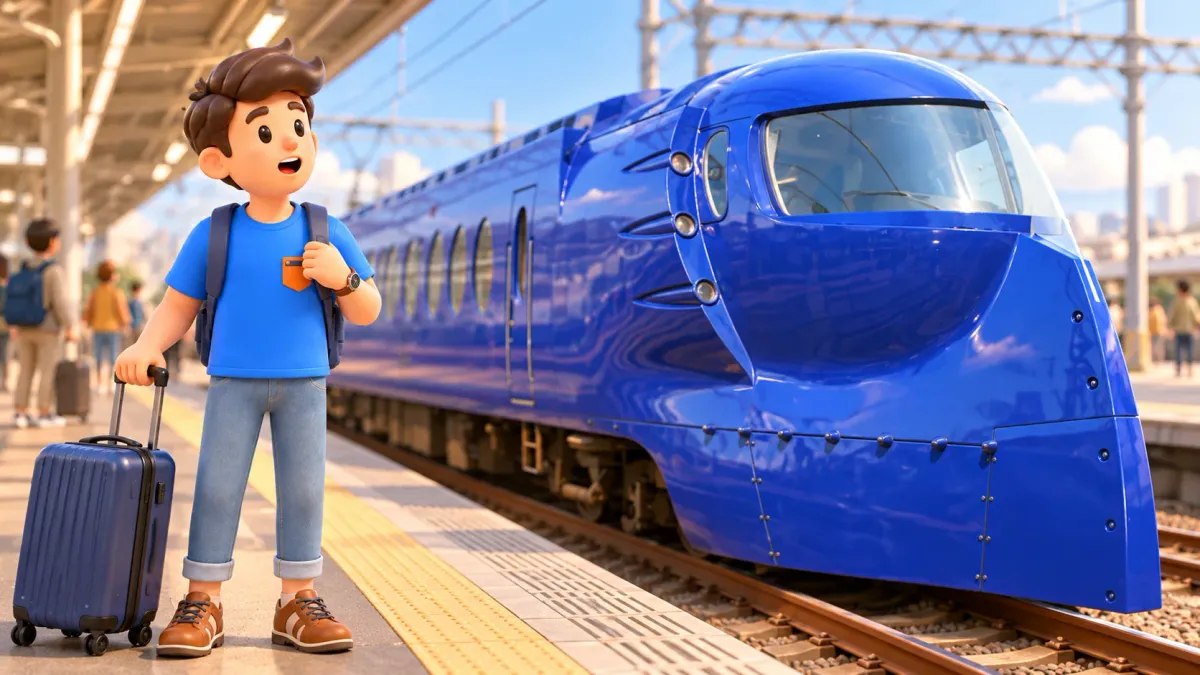
The blue train's round windows are deliberate: Nankai describes a retro-futurist design inspired partly by aircraft windows. It is a distinctive arrival experience, but choose it for seating, timing and comfort rather than assuming it is the only usable airport train.

A digital Rapi:t purchase still needs a train and seat
The official Rapi:t Digital Ticket combines the journey with the selected limited-express class. After buying it, specify the boarding date, train and seat in the ticket wallet. A purchase confirmation alone does not complete those steps or automatically reserve the next departure after your aircraft lands.
The current product allows seat selection until five minutes before departure, subject to availability. Its train-change conditions also have a five-minute cutoff and a limit on changes. Check the terms displayed for your actual purchase; a reseller voucher may follow another procedure.
Use the designated digital-ticket gate and the ticket displayed as instructed. A screenshot is not a reliable substitute for an active ticket. If the phone cannot display it because it is lost, broken or out of battery, the provider's conditions do not promise a replacement or refund.
After a long-haul flight, selecting a departure only once you can realistically reach it may be less stressful than an extremely tight advance reservation. Compare flexibility and seat availability. Neither a prepaid ticket nor a flight arrival time guarantees that immigration and baggage will finish on schedule.
Umeda: JR to Osaka Station
For the Osaka Station and Umeda area, compare JR's Kansai Airport Rapid with HARUKA. The airport lists roughly 65 minutes for the rapid service to Osaka Station. HARUKA is a different limited-express product and also serves Tennoji and Shin-Osaka; choose a departure that stops where you need it.
The word Osaka in a booking must be read carefully. Osaka Station is useful for Umeda; Shin-Osaka is the separate Shinkansen station. Reaching one does not automatically place you at a hotel beside the other, and a Shinkansen connection requires its own appropriate ticket.
At Osaka Station, HARUKA uses the underground Umekita area, whereas other services use different platforms. Follow your train's current signs rather than a photograph of another JR platform. Allow walking time through the station before deciding whether an onward connection is comfortable.
The rapid service can be attractive when you do not need a reserved airport-express seat. HARUKA may be preferable for your actual stop and selected ticket. Compare the complete fare and departure, not a universal claim that one JR option is always better for every visitor.
HARUKA discount: eligibility and the November change
The specific HARUKA One-way Ticket discussed here is a discounted product with conditions, not the universal fare for every passenger. JR-West requires a foreign-government passport and Temporary Visitor status. Check eligibility and reception instructions before buying; speaking English or arriving on an international flight is not itself qualification.
For Osaka or Shin-Osaka, the published adult price changes according to the purchase date, not the exchange or use date. A purchase through 31 October 2026 belongs to the earlier price band; purchases from 1 November use the announced new band. Do not apply an old screenshot automatically to a later purchase.
For JR-West's online-reservation route, collection requires the stated reservation details, passport and the payment card. The product page excludes virtual and numberless credit cards for that route. If your payment method does not satisfy those conditions, choose a workable alternative before committing.
Machine collection requires an IC-chip passport; the page directs travellers without one to a ticket office. A travel-agency exchange order is another fulfilment route with its own instructions. Keep the seller's collection information instead of assuming every digital confirmation opens the gate directly.
JR-West also offers a separate WEST QR route through participating sellers, with direct QR boarding after the required registration. Its existence does not turn a collection-based reservation into a QR ticket: follow the product actually purchased.
Sample prices: compare complete products
The following adult one-way examples are a dated snapshot, not a promise of availability. Prices are payable in yen. Your bank may apply its own exchange rate and charges when your account uses another currency. Compare the actual checkout amount for your chosen date.
| Specific product | Published amount | Important limit |
|---|---|---|
| Rapi:t Digital Ticket, regular seat, to Namba | JPY 1,410 | Combined product; select train and seat |
| Discounted HARUKA One-way Ticket to Osaka / Shin-Osaka, purchases through 31 October 2026 | JPY 1,800 | Eligibility and collection conditions apply |
| The same HARUKA discount product, purchases from 1 November 2026 | JPY 1,900 | New purchase-date band |
| Airport bus to Osaka Station / Umeda | JPY 1,800 | Actual stop and available departure matter |
Add the onward city fare and realistic final walk when comparing. A slightly cheaper airport leg can lose its advantage if it arrives across town from the hotel. Our guide to planning a travel budget helps include those easily missed costs.

When the limousine bus is simpler
The airport bus to the Osaka Station area serves named stops such as Herbis Osaka and Hankyu Sanbangai; individual departures do not necessarily serve every listed stop. Find the stop closest to the accommodation and read that column, rather than treating Umeda as one drop-off point.
KATE lists about an hour from Terminal 1 to Hankyu Sanbangai, with additional time for the Terminal 2 section. Road traffic can change the result. A bus can nevertheless be practical if it avoids a complicated station walk and another train with heavy luggage.
The current Osaka Station route is first-come, first-served without reservations. A purchased ticket should not be interpreted as a guaranteed seat on any departure you choose. Join the correct queue and follow staff instructions for bags and boarding.
The timetable marks certain late-night departures as cashless only and warns that no extra bus is provided when full. This is a specific condition of marked services, not evidence of an all-night guaranteed shuttle. Check current terminal, payment method and availability before relying on one.
Late arrival: check the final connection too
Build the journey from the time you can actually leave arrivals, including border control, baggage and the Terminal 2 shuttle if needed. A timetable measured from the scheduled landing time is too optimistic when the train departs before you can reach its platform.
Check the last usable connection all the way to the accommodation. Reaching Namba or Umeda on a late train does not prove that the next metro line is still running. A longer final walk or short taxi may change which airport option is sensible.
Save a backup before departure: a later workable public service, a properly arranged car or accommodation you have actually checked. Avoid relying on a decades-old blog statement that there is always a bus after the last train.
Tell the hotel if arrival may be late and obtain its actual check-in instructions. Transport running to the district does not keep the reception open. Our late-night arrival guide explains how to coordinate the transfer and access to your room.
Taxi and private transfer: compare the whole quote
A car is worth comparing for several travellers, substantial luggage or an arrival after public services. Ask whether the quote covers the actual destination, road tolls, waiting after flight delays and the vehicle size you need. An advertised starting price for another district is not your final bill.
Use the airport's official taxi arrangements or the meeting instructions from your booked operator. Reserved-car and app pickup areas can differ from the ordinary taxi rank. Follow current airport directions; a random driver approaching in the arrivals hall is not a substitute for a confirmed booking.
Do not confuse Kansai Airport with Itami in a car-booking form. Check KIX, terminal, flight date and destination before payment. This small verification is more useful than trying to memorise a universal taxi price for the whole of Osaka.
Luggage, accessibility and a manageable arrival
Rapi:t has dedicated luggage space, but that does not remove the need to handle bags between terminal, gate, carriage and hotel. On any service, follow the operator's size and storage rules; do not block doors or assume a large suitcase fits every overhead shelf.
For limited mobility, look at the complete chain: terminal movement, lifts, platform access, boarding assistance and final street entrance. Arrange help with the relevant operator where needed. A station having a lift does not guarantee that the shortest online walking route uses it.

For the return, search again
On the return trip, select Kansai-Airport Station and the correct terminal, not merely a station with Osaka in its name. For a joined JR Kansai Airport Rapid / Kishuji Rapid formation, only the airport-bound section continues to the airport after separation at Hineno. Check carriage destination displays and staff instructions before boarding.
Once the transfer is settled, let RoadMe work out a complete personal sightseeing plan around your interests and a comfortable pace in supported destinations. Following it in the app is easier than rebuilding the holiday around a train ticket bought for the wrong district.
Before buying, confirm KIX, terminal, destination station, complete ticket entitlement and last workable connection. Nankai makes sense for Namba, JR for its actual Osaka-area stops, and the bus when its real stop improves the final journey. Your accommodation address decides which comparison matters.