How to use OMNY in New York: subway fares, buses and fare caps
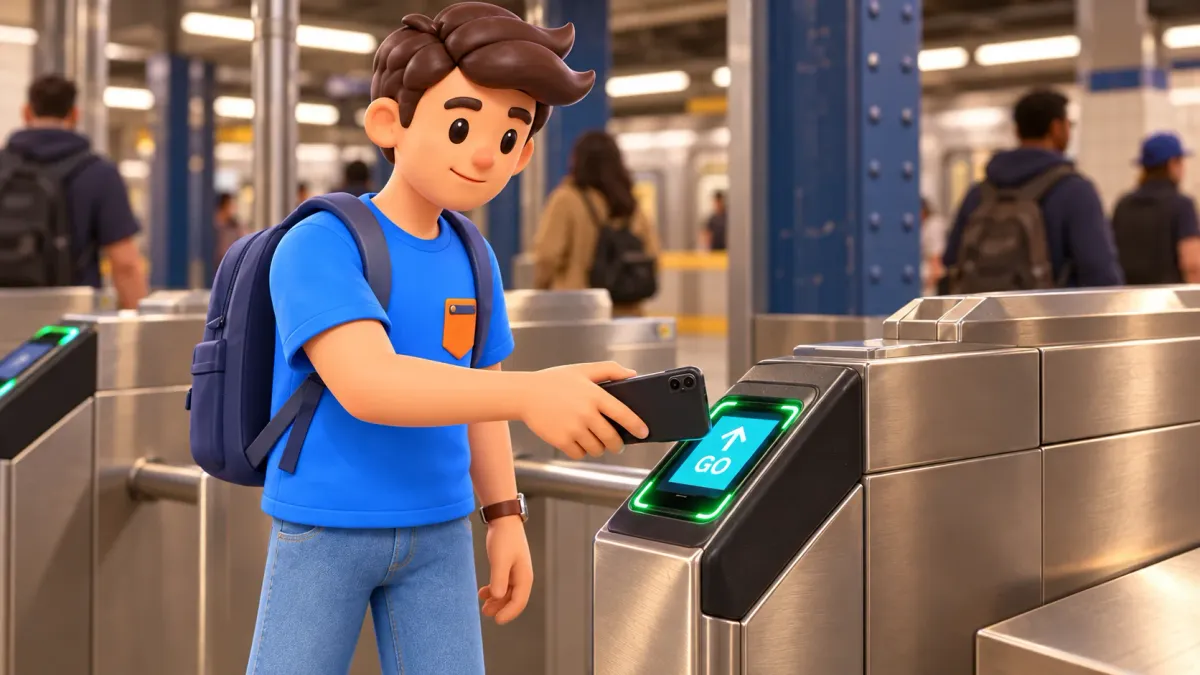
To pay for the New York subway or a local bus with OMNY, tap a contactless bank card, a phone or watch with a supported wallet, or a reloadable OMNY Card. Wait for the reader to confirm acceptance. For a useful weekly saving, keep using exactly the same payment method: the plastic card and its version in your phone have separate fare records.
This guide covers ordinary full-fare tourist travel, the seven-day cap, transfers and practical payment problems. Conditions were checked on 26 October 2026. Airport trains, commuter rail and express buses should not be treated as identical to an ordinary subway ride, even when a reader looks familiar.
Choose one way to pay before your first journey
OMNY is the payment system, not an app you must download before entering the subway. If you have a suitable bank card that works abroad, you can usually start by tapping it directly. A supported mobile wallet is another option. An OMNY Card is the separate transport card you buy and load with value, useful when paying cash or keeping travel separate from your bank card.
| Payment choice | What to prepare | What to keep consistent |
|---|---|---|
| Contactless bank card | Check overseas use and remove it from your wallet | The same physical card |
| Phone or watch | A working supported wallet and enough battery | The same device and wallet card |
| Reloadable OMNY Card | Buy it and add sufficient travel value | The same transport card |
For a more convenient sightseeing day, try RoadMe: in supported cities, the app develops a personal trip plan around your interests, dates and pace. A coherent programme makes it easier to fit transport around the places you actually want to visit.
Choose the method you can reliably use for the whole visit, rather than alternating simply because both options draw on one bank account. A backup is sensible for a rejected payment or a flat battery, but switching starts a different payment record. A transport card does not make an otherwise unusable foreign bank card work; cash loading is a different solution.
How to pass the subway turnstile
- Check the entrance and train direction before paying. Some entrances do not provide the direction you need.
- Take out one card, or select the intended card in your mobile wallet.
- Hold it at the OMNY reader on the turnstile and wait for the green acceptance message, GO.
- Go through after acceptance. Do not present a second device just because you have not yet seen a bank notification.
- Keep the same payment method for a qualifying transfer and later journeys.
You tap when entering the subway, not when leaving. This differs from networks that calculate a distance fare using both entry and exit. Do not search for an exit payment merely because you used that pattern elsewhere. If the reader does not accept the payment, stop before the gate and resolve it without blocking the next passenger.
Hold the chosen card outside a wallet containing several contactless cards. Presenting the entire wallet can charge a different card than intended. With a phone, check the selected wallet card rather than assuming the last card you used in a shop will necessarily be the right one for your travel record.

What the ordinary fare and weekly cap mean
The current ordinary subway and local-bus fare is $3. The subway and local-bus cap is $35 within a seven-day period when you keep using the same payment method. The period starts with your first tap; it is not automatically Monday to Sunday. There is no need to buy an unlimited weekly pass in advance to start accumulating the cap.
If you travel little, you pay for the eligible journeys you make. If your counted fares reach the cap, further eligible rides during that same period are free. This is a limit on qualifying transit fares, not a refund of all city transport spending. Bank foreign-transaction fees and separately charged services are not turned into free travel by reaching it.
Express buses have a different fare and a higher combined cap: the operator currently lists $7.25 for a ride and $67 over seven days including subway, local and express buses. Do not apply the lower cap to every vehicle called a bus. Check the service type, particularly when a journey crosses a long distance between boroughs.
A useful calculation without buying too much upfront
Consider one person taking two eligible paid rides on each of five days, always with the same card. Ten ordinary fares total $30. That person has not reached the $35 cap, and paying only for those rides is lower than the cap. The example deliberately excludes free transfers, other people and airport charges.
Now imagine that the same visitor makes more eligible journeys within the same seven-day period. The running fare total is capped at $35 instead of continuing indefinitely at the ordinary rate. Do not use a simple count of bank entries to decide whether the threshold has been reached: authorisations, settlement and free transfers can make the statement look different from a list of paid rides.
The practical question is therefore not “How many trips must I force into my stay?” Plan the journeys you need and keep the method consistent. Adding unnecessary subway rides to earn a benefit consumes time and does not improve the visit. A walk between genuinely nearby sights can still be the more pleasant choice.
Why the same bank account can produce two caps
OMNY distinguishes a physical bank card from that card inside a phone. It also distinguishes different cards within one wallet. A watch and phone should not be casually interchanged when you want one continuous record. The operator's rule is the same device and the same wallet card for every relevant tap.
For example, paying the first part of a journey with plastic and the bus with the phone does not preserve a free transfer just because both payments reach the same bank account. Similarly, spending part of the week on one method and the rest on another does not combine the two amounts into one weekly cap.
Keep a simple private note of the method you chose, especially when travelling with several cards. You do not need to put a full card number in a shared travel document. If your device fails, use a safe workable backup to continue the journey and accept that its fare record may be separate.
Transfers: a time window with conditions
The MTA describes one free transfer within two hours of paying the fare between subway and bus, bus and subway, or bus and bus. Use the same payment method for both parts. A free transfer does not add another paid fare toward the weekly cap.
This is not a promise that you can repeatedly leave and re-enter any subway station for two hours. Subway connections inside the paid area work differently from exiting to the street and paying at another entrance. The MTA identifies specific permitted out-of-system connections; do not generalise those exceptions to every pair of stations.
A transfer to an express bus can require paying the fare difference. A transfer to or from AirTrain JFK is not free under the ordinary subway-and-bus transfer rule. Separate the airport leg from the subway leg when estimating your arrival budget, instead of assuming the word “transfer” means all connecting transport is included.
Can a couple or family share one card?
For an ordinary full-fare method, OMNY allows payment for yourself and up to three additional riders on one trip. Tap once for each person. This is convenient for an occasional shared journey, but it does not give four people one combined weekly discount: only the first tap counts toward the cap.
Once that payment method has earned free rides, only its first tap is free; the extra riders still pay their fares. If several people will make many trips, consider a separate reliable payment method for each fare-paying person so each can accumulate their own cap. Do not confuse one shared bank account with one shared travel entitlement.
For a group transfer, the operator says to tap all riders at the same reader, including when continuing the journey. Using different readers, even in the same station or vehicle, can lose those group transfers. A newly used payment method may also require a short wait, about a minute, before another group tap. Ask staff if the sequence does not work.

Children: check height, not a guessed age rule
On the subway and the local, limited, rush and Select Bus Service buses, up to three children under 44 inches tall may travel free with a fare-paying adult. That is approximately 112 centimetres, but the official threshold is 44 inches. Do not replace it with an invented rule such as “all children under a certain age travel free”.
Express buses have a separate child rule, so a family should check that service before boarding. Student and Reduced-Fare products also have their own eligibility and restrictions. An ordinary tourist should not borrow another person's concession card or assume that the general group-payment instructions apply unchanged to a special card.
Using buses and buying a physical OMNY Card
On ordinary local, limited, rush and express buses, board at the front door and tap the reader. On Select Bus Service, the MTA allows boarding at any door with a tap. Identify the actual service before following a passenger through another door; a familiar-looking bus is not enough to establish its boarding procedure.
To use a physical OMNY Card, buy and load one at an OMNY vending machine or a participating retailer. The machine can also show the balance. Cash is an option for buying or loading a transport card, so direct bank-card payment is not the only way into the system. Check the purchase charge and loaded value separately at the point of sale.
Adding a card to a free OMNY account enables online loading and balance protection features. Registration is useful, but is not required merely to tap and ride with an accepted payment method. Keep enough usable balance for the journey; buying a card and loading it are distinct actions.
What to do when a tap is rejected
First check the obvious: have you presented the intended card, is the OMNY Card balance sufficient, and does the device have power and an available wallet? If the reader still rejects payment, move aside and ask a station employee or use another valid method. Do not keep changing cards while pushing against the gate.
A bank rejection can require action with the issuing bank. An unpaid fare can also leave a method blocked in OMNY until the issue is resolved. The operator provides customer support and account tools for this. Switching to another method may let you continue, but does not merge its spending with the blocked method's cap.
If a machine transaction fails, retain whatever receipt or transaction details you have. Note the station, time and machine number for support. Never share a full bank-card number, security code or wallet access with someone offering unofficial help. Ask identifiable transit staff rather than a stranger to operate your payment.
Charges, airport travel and the end of MetroCard sales
A temporary bank authorisation can appear when a method is first used; OMNY says it is reversed when the actual fare is charged. Compare trip and charge history before deciding that every pending line is an extra fare. An optional OMNY account helps track the cap and completed journeys.
MetroCard sales and refills ended from 1 January 2026. Existing valid remaining value is a separate transition matter; check the MTA's current acceptance notice if you still have an old card. Do not plan a new holiday around buying a fresh MetroCard from an outdated guide, or assume that the end of sales and the end of all acceptance are the same date.
For arrival with bags, separate fare payment from airport access and storage decisions. Our guide to luggage storage in New York helps with the interval before check-in, while the late-night arrival guide covers arranging the transfer and access to your accommodation.

Before you head for the station
- Choose a working payment method for each fare-paying traveller.
- Keep physical cards, phones and watches distinct in your planning.
- Check direction and current service before entering.
- Tap once per rider and look for acceptance.
- Use the same method for qualifying transfers and the weekly cap.
- Budget separately for airport and other excluded services.
To turn those journeys into a personal sightseeing programme, open RoadMe: in supported cities, the app builds a complete plan around what interests you and how you prefer to travel. It is a convenient way to organise the visit while checking current transport operations with the operator.
You do not need to master every fare product before your first ride. For most ordinary visits, the useful foundation is one accepted payment method per regular rider, a clear understanding of transfers, and the same method throughout the seven-day period. Recheck the current fare when travelling after the date of this guide.