
How to Spot a Suspicious Vacation Rental Listing
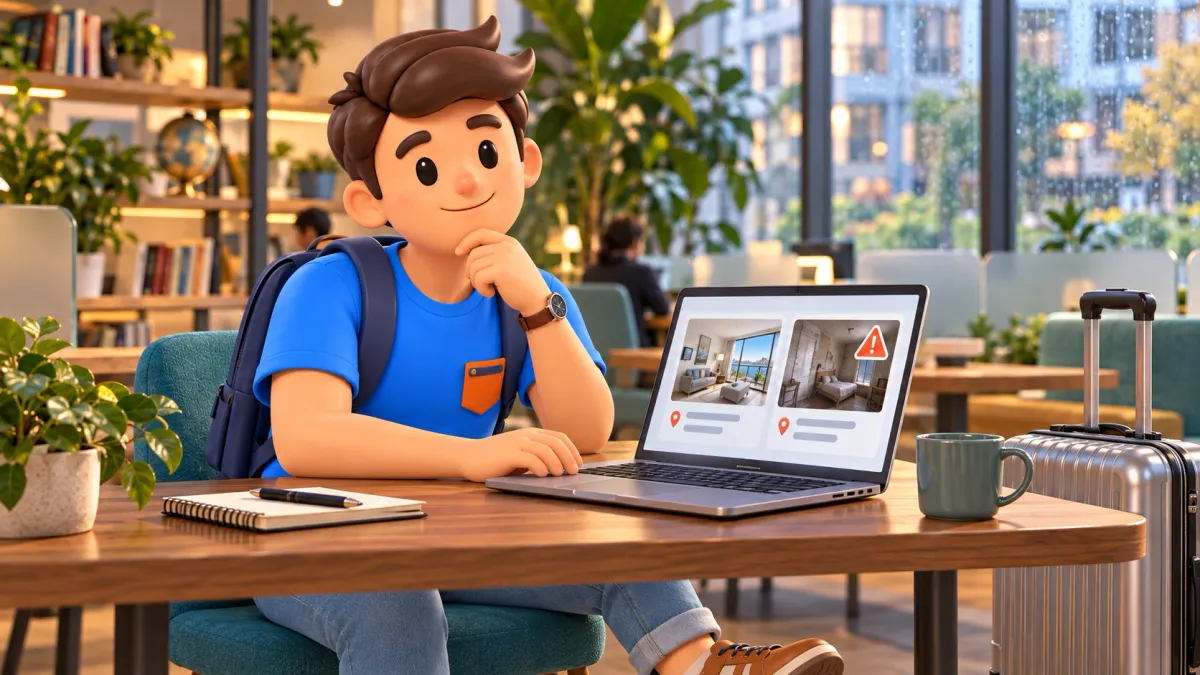
Pause before paying if a host pressures you to transfer money, sends you to an unfamiliar checkout page or will not confirm what you are booking. Check the property, the person or company taking payment, the written terms and the payment rules independently. If someone asks you to share a banking password or one-time security code, stop the conversation immediately.
This guide covers apartments, houses and other short-term rentals for a trip. It helps you decide whether to continue a booking, ask for clarification or choose another property. A low price or a new listing is a reason to investigate; neither proves fraud. Equally, attractive photos and a message that appears to come from a familiar service are not enough to establish trust.
Establish what a comparable stay actually costs
Compare several properties for the same dates, guest count, accommodation type and area. An entire apartment is not comparable with a private room, and a nightly headline price is not the cost of the whole stay. Include mandatory cleaning and guest charges before judging how unusual a discount looks.
Choose the area around the trip you want to take. An appealing description such as “central luxury apartment” is less useful than knowing which neighbourhoods work for your visits and transport connections.
Before narrowing down your accommodation area, you can outline your visits in RoadMe. Its day-by-day planning takes your interests and pace into account, giving you a starting point for choosing where to stay.
Ask why a much cheaper property costs less. Open dates, a less convenient floor or nearby construction may explain the difference. The explanation should match the listing and remain consistent when you ask practical questions. Pressure to pay instead of an answer is a reason to pause.
Check whether the property and the advertiser fit together
Search for the address, property name and management company separately from the advertiser’s link. Check whether the building exists and whether its surroundings fit the description. For a rental advertised within a resort or managed complex, find the reception or management contact independently and ask about the property.
Run a reverse image search on several listing photos. Matching images on multiple booking sites may belong to the same legitimate operator. The same rooms assigned to different towns, incompatible layouts or unrelated addresses need an explanation. Finding no matches does not verify a listing either.
Look at recent reviews for the specific property, including details about check-in and the accommodation itself. A long profile history can add context, but it does not replace checking the current offer. A new property with no reviews needs other evidence rather than an automatic rejection.
If details conflict, ask about the floor, entrance, room layout and key collection. Extra photos or a video walkthrough may clarify the space, but they do not prove that the person offering it is entitled to rent it out. Some platforms withhold an exact address until a booking is confirmed. Check their policy and establish what location information you can see before paying.

Follow the payment rules of the service you are using
Open the booking app yourself and look for the reservation and any payment request there. For an unfamiliar message, use support reached through the app or the official website you opened independently. A copied logo, professional invoice or convincing email design does not establish who is receiving your money.
For example, Airbnb prohibits moving a reservation off its platform. Its policies allow certain disclosed exceptions for taxes, hotel charges and fees or deposits collected by select software-connected hosts. An unexpected request therefore needs checking against both the reservation and the current policy; “all payments outside the platform are always fraudulent” is too broad.
For a direct booking, establish who you are dealing with and obtain the terms before paying a deposit. Check the connection between the rental, the contracting party and the payment recipient. If the names differ, ask for an explanation you can verify independently. A bank account number does not establish that connection.
Do not buy gift cards or send cryptocurrency to an unknown advertiser to secure a holiday rental. Treat pressure to use a money-transfer service, abandon the booking platform or pay before basic questions are answered as a reason to walk away. Payment protections differ by country, provider and transaction type; no payment method verifies the property itself.
Save the terms and question unexpected requests for personal data
Before paying, keep the listing and a written confirmation of:
- the specific property, stay dates and guest count;
- the total price, deposit or advance payment, remaining balance and mandatory charges;
- cancellation terms and security deposit conditions;
- check-in time, access arrangements and the contact for arrival;
- the person or company responsible for providing the accommodation.
A manager or agent may legitimately act for an owner. Ask how they are connected to the rental; a photograph of someone’s ID alone does not prove authority. For help separating legitimate charges, see the guide to accommodation deposits, tourist taxes and cleaning fees.
Guest identification can be required for local registration or compliance. Before sending a document copy, establish what is needed, why, who receives it and how it should be submitted. Airbnb’s policy, for instance, permits certain legal or compliance requirements when disclosed in the listing. Check an unexpected request with the platform through an independent channel.
Never tell a host or caller your account password, banking PIN or one-time security code. Entering a code to approve your own payment through a verified bank interface is different from giving it to another person. Do not provide remote access to your device to “complete a booking” or “release a refund.”
Turn each warning sign into a check you can perform
| Warning sign | What to check | When to stop |
|---|---|---|
| The price is far below similar stays | Matching dates, accommodation type, total charges and the explanation | The terms do not explain the difference and you are pressured to pay |
| Photos appear in other listings | Addresses, descriptions and the operator’s connection to the properties | Incompatible properties use the same rooms and the conflict remains unexplained |
| The exact address is withheld | The platform’s policy, the advertised area and when the address will be provided | You cannot establish which property is being offered before payment |
| An unexpected payment is requested | Your reservation, the service’s rules and the purpose of the charge | The request contradicts the rules or tells you to bypass support |
| Someone asks for a banking code or password | Share nothing; contact your bank independently | Immediately: a host does not need these credentials |
You do not need a particular number of warning signs before stopping. One request for confidential banking credentials is enough. A less conclusive detail, such as a new profile, calls for investigation rather than an accusation.
Consider this hypothetical example: a message arrives after booking, quoting your correct travel dates and demanding a new “verification payment” to prevent cancellation. Accurate booking details do not authenticate the sender. Open the reservation independently and ask official support to check the request before you take any action.
Choose a replacement independently if the checks do not add up
Time spent discussing a rental is not a reason to continue with an unexplained payment request. Report the suspicious message to the platform and search for another property through a channel you choose yourself.
If the advertiser says the original home has become unavailable and offers a substitute, check the new property, price and terms from the beginning. Do not assume the original listing’s reviews apply to another address. If you have already paid, ask the platform about the appropriate complaint or cancellation process before following the sender’s instructions to cancel and accept a separate refund.
A replacement in another neighbourhood may also change how you organise your days. Recheck transport connections and the visits closest to your new base.
If a change of accommodation affects your sightseeing plans, you can use RoadMe to remove or replace stops that no longer suit the trip. Adjust the visits around the new location and the pace you prefer.
Act promptly if you have already paid or shared information
Stop further payments and contact your bank, card issuer or payment provider through its official channel. Explain the suspected scam and ask whether the payment can be stopped, recalled or disputed. Be accurate about whether you authorised it yourself or discovered an unauthorised transaction. Available remedies depend on the circumstances and applicable rules; recovery is not guaranteed.
If you disclosed card details or a banking code, tell the bank immediately and follow its account-protection process. For an exposed email or booking password, change it through the genuine service, change reused passwords elsewhere and enable two-factor authentication where available.
Save the listing address, screenshots of the terms, messages, recipient details and payment confirmation. Report the issue to the booking platform and, where appropriate, the police or fraud-reporting service for your jurisdiction. Do not pay the suspicious sender another fee to “unlock” a refund.
A booking should leave you with an identifiable property, agreed terms and a payment process you can check independently. If those remain unclear while pressure or demands for confidential information increase, choose another place to stay.


