Grand Canyon South Rim or West Rim: Tickets and Differences
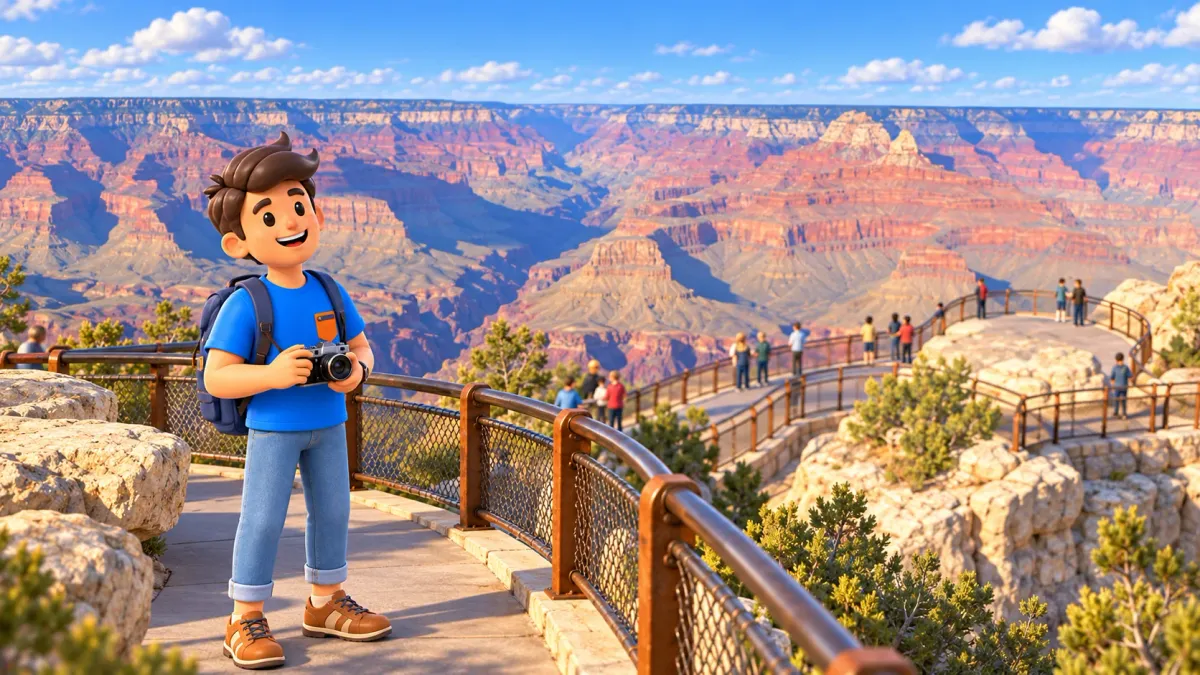
Choose the South Rim if your priority is Grand Canyon National Park and time to absorb its landscape. Choose Grand Canyon West if the Skywalk is central to your visit or its location works better with a stay in Las Vegas. These are separate destinations with separate admission systems, not two entrances covered by the same ticket. Decide which experience you want before booking transport, accommodation or a pass.
South Rim or West Rim: decide what the visit is for
The South Rim is the national-park choice: canyon views, visitor facilities and the possibility of spending time at the rim without buying an attraction package. Grand Canyon West is operated by the Hualapai Tribe on its reservation. Its best-known experience is the horseshoe-shaped glass Skywalk. Both involve the real Grand Canyon; neither is a substitute location secretly pretending to be the other.
Ask everyone in your group to complete this sentence: “I will be disappointed if we miss…” If the answer is the glass bridge, booking the South Rim will not solve it. If the answer is an unhurried national-park visit, a tightly scheduled West Rim excursion may not deliver the day you imagined. Start with that difference rather than a general claim about which side is better.
If the canyon visit is part of a wider city break, try RoadMe to build a personalised city plan around your interests, available days and pace in supported destinations. It makes the surrounding sightseeing easier to organise while you reserve the canyon day separately.
| Question | South Rim | Grand Canyon West |
|---|---|---|
| Who manages the destination? | National Park Service | Hualapai Tribe |
| Is this Grand Canyon National Park? | Yes | No; this is a separate destination |
| Is the Skywalk here? | No | Yes, at Eagle Point |
| Does a national-park pass pay for West admission? | Check the applicable park-pass coverage here | No |
| What should drive the choice? | The park experience and time available | The desired attractions and a workable visit from your base |
The map matters more than the word “rim”
Two labels on the same canyon do not mean two nearby stops. The National Park Service describes the drive between the South Rim and Grand Canyon West as about 250 miles, or 400 kilometres, taking roughly five hours. Treat that as a broad planning estimate, with additional time for actual road conditions and stops. Do not plan to switch between them casually after discovering that a ticket is for the wrong place.
When checking a booking, find the exact destination name, meeting point and road journey. A listing headed simply “Grand Canyon” could describe very different products. Read the detailed stop list, not only the large photograph. A photograph does not prove that the activity shown is included.
West is generally the closer choice from Las Vegas, but the shortest transfer does not automatically produce the best visit for your group. Compare the time you actually spend at the destination with the full time away from your hotel. A coach tour includes collection, other passengers and possible intermediate stops; the driving estimate in a car is not the excursion timetable.
For an independent trip, save the full destination name in your navigation app before departure. Match it to your ticket or lodging confirmation. If the route, arrival point and description disagree, resolve the discrepancy before setting off. Avoid navigating only to a broad canyon label or assuming the first result is your entrance.
South Rim admission: check the complete 2026 cost
The standard private, non-commercial vehicle entrance fee is $35, valid for seven days. In 2026, non-US residents aged 16 and over also face a $100 per-person fee unless covered by a qualifying valid pass. The non-resident America the Beautiful Annual Pass costs $250. Check eligibility and coverage for your actual party: speaking English, holding a foreign passport or travelling on a particular airline does not by itself describe everyone's residency situation.
Here is an illustrative calculation for visitors who all owe the additional non-resident fee, share one private car and have no qualifying pass. One adult produces $35 + $100 = $135; two produce $235; three produce $335. In the third case, comparing the applicable $250 annual pass becomes particularly useful. This is a calculation under stated conditions, not a promise that every group must buy it.
Check the holder's identity requirements and keep the actual pass available. Do not assume an inexpensive resident-only product is available to you, or that a screenshot from someone else's account is sufficient evidence. For a commercial tour, ask the operator how admission and any applicable non-resident charge appear in the quoted total.
The park currently requires neither a general entry reservation nor a timed-entry booking, and entrance stations are cashless. That does not reserve accommodation, a campsite or a separate activity. Our guide to national-park permits and visitor rules explains how to keep those different confirmations separate.
Compare costs for your own visit rather than copying a friend's total. Record the people covered, the vehicle arrangement, the dates and any pass already held. Then add transport, lodging and meals. An admission price may be a relatively small part of the full decision if reaching the destination requires a very long day or an additional overnight stay.
Grand Canyon West tickets: read the product, not an old price
Grand Canyon West's current visitor information presents an All-Access Pass with Skywalk access and its internal shuttle. Prices depend on the selected visit date, and applicable taxes and fees must be included in your comparison. National-park passes do not pay for admission here. Avoid using an old “general admission plus separate Skywalk” breakdown as a reliable description of today's offer.
Before paying, open the details of the exact product you have selected. Look for its visit date, included attractions, arrival conditions, exclusions and cancellation terms. A professional photograph, a flight, food or a discount on a meal is not automatically the same as an included activity or a free meal. Separate the base visit from optional purchases you actually want.
Skywalk access is subject to availability; an included attraction does not mean a private, queue-free slot. Keep enough flexibility that a wait or a weather interruption does not leave you with an impossible departure. If a particular experience is the sole reason for travelling, read its specific conditions rather than relying on the name “All-Access”.
For a fair comparison, write down the final payable West total and the complete applicable South Rim admission total beside one another. Then add the transport and time required by each. Comparing a per-person package with a per-vehicle park fee, while omitting the non-resident charge, creates a misleading result even when each copied number was once correct.
If you are booking through another seller, establish who handles changes and refunds. Keep the seller's confirmation with the destination and inclusions visible. Do not make a second purchase simply because the confirmation uses a different product label; ask what your existing booking admits you to first.
What you will do once you arrive
At the South Rim, think in terms of time at the canyon rather than collecting the longest possible list of viewpoints. The park's free village-area shuttle system can help with local movement, but the current routes, operating periods and access conditions still matter. Arriving by car does not establish that every road or parking area is available exactly when you want it.
At Grand Canyon West, private vehicles remain in designated parking areas and visitors use the internal shuttle between attractions. Plan around that change of transport rather than expecting to drive directly from one rim attraction to the next. Keep what you need for the visit accessible, instead of leaving it buried in luggage you will not carry around.
Neither choice requires you to turn the day into a demanding hike to justify the journey. An extended look at the canyon, a comfortable break and attention to the landscape may be more rewarding than adding physical effort simply because a guide mentions it. A sightseeing comparison is not a preparation plan for entering the inner canyon.
If you are travelling with children or someone with limited mobility, describe the practical requirements before booking: walking tolerance, steps, boarding transport, rest breaks and toilet access. Ask about the exact facilities you need. “Accessible” and “family friendly” are broad descriptions; a named boarding arrangement or a confirmed step-free section is a more useful answer.

Why the setting deserves more than a quick photograph
The canyon is a landscape of exposed rock layers shaped over immense timescales, with the Colorado River central to its story. Looking across those layers is more revealing when you give your eyes time to distinguish foreground cliffs, intermediate formations and the distant rim. Different light can change the apparent depth without requiring you to move to a new location every few minutes.
Grand Canyon West also sits within living Hualapai homelands. The Hualapai Reservation was established in 1883, and the Tribe operates the visitor destination. Treat cultural experiences as part of a present-day community rather than background scenery for an attraction. Follow the stated rules for photography and access instead of assuming that buying admission opens every nearby area.
A useful approach is to choose one question to explore during the visit. You might want to understand the visible layers, notice how scale changes with the light, or learn more about the place from its interpreters. That gives the day a purpose beyond reproducing a photograph you saw while booking.
You do not need a geology lecture before departure. Read the information available where you visit, ask questions when staff or guides are available and leave room to look. A shorter list of stops can make this easier, particularly if the journey already uses a large part of your available time.
Weather, clothing and photographs
The South Rim operates year-round, but year-round access is not a guarantee of clear roads, warm conditions or unobstructed views. Winter weather deserves a separate check. The inner canyon has different conditions from the rim; do not use one forecast as proof that a descent is suitable. This article compares sightseeing destinations and does not recommend a canyon hike.
At West, weather can affect attractions, transport and operating conditions. Pack for the forecast and the time you expect to remain outdoors, including the return journey. Comfortable shoes and layers are more useful than dressing only for the warmest image on a booking page. If conditions change, follow local instructions rather than trying to recover every planned photograph.
For the Skywalk, the current FAQ permits phones while restricting other personal items such as cameras and bags; lockers are provided. Check the latest entry instructions for what you intend to carry. Keep photography within the permitted area and never reach beyond a railing for a shot. A rule seen in an old travel review may no longer describe the current arrangement.
Elsewhere, take photographs only from permitted positions. A dramatic image is not evidence that a place is safe to stand, and a gap in a crowd is not permission to cross a barrier. Give other visitors space and put the camera away long enough to see the view without deciding how to frame it.
A simple way to make the final choice
Consider two fictional groups. One is based in Las Vegas and cares above all about the glass bridge. The other has made space for a national-park stay and wants time for views without a tightly packed attraction schedule. West fits the first group's stated purpose; the South Rim fits the second. These are planning examples, not results of a tested itinerary or a universal ranking.
If your group is divided, compare the non-negotiable experience, full cost and travel burden in that order. A cheaper ticket does not compensate for missing the one thing someone wanted. Equally, a famous attraction is not automatically worth changing an otherwise comfortable trip around. Decide what you are willing to leave for another visit.
For the city portion before or after the canyon, RoadMe can turn your interests and available time into a complete personalised sightseeing plan in supported cities. Try a lighter pace around the excursion so the rest of the trip feels easier to manage.
If you have not yet settled the wider holiday, our guide to choosing a destination for your interests and budget helps put this decision in context. The aim is a visit that belongs in your trip, rather than a famous name added at any cost.
Before you confirm the booking
- Name the destination precisely. South Rim in Grand Canyon National Park or Grand Canyon West on Hualapai land.
- Match the experience. Check whether the Skywalk, a park visit or another activity is actually included.
- Price the whole group. Include applicable residency-based charges, taxes, fees, transport and optional purchases.
- Check the actual day. Review the destination's current conditions, your arrival time and the return arrangement.
- Keep the right confirmations. Admission, accommodation and transport can be separate bookings with different conditions.
The strongest choice is the one you can explain in a sentence: we chose this destination because it gives us the experience we want, at a cost and pace we understand. Once that is clear, the ticket and transport decisions become much simpler. You do not need to visit both rims to have made a worthwhile first visit to the Grand Canyon.