
Galileo and the Leaning Tower: Pisa’s History and Legend
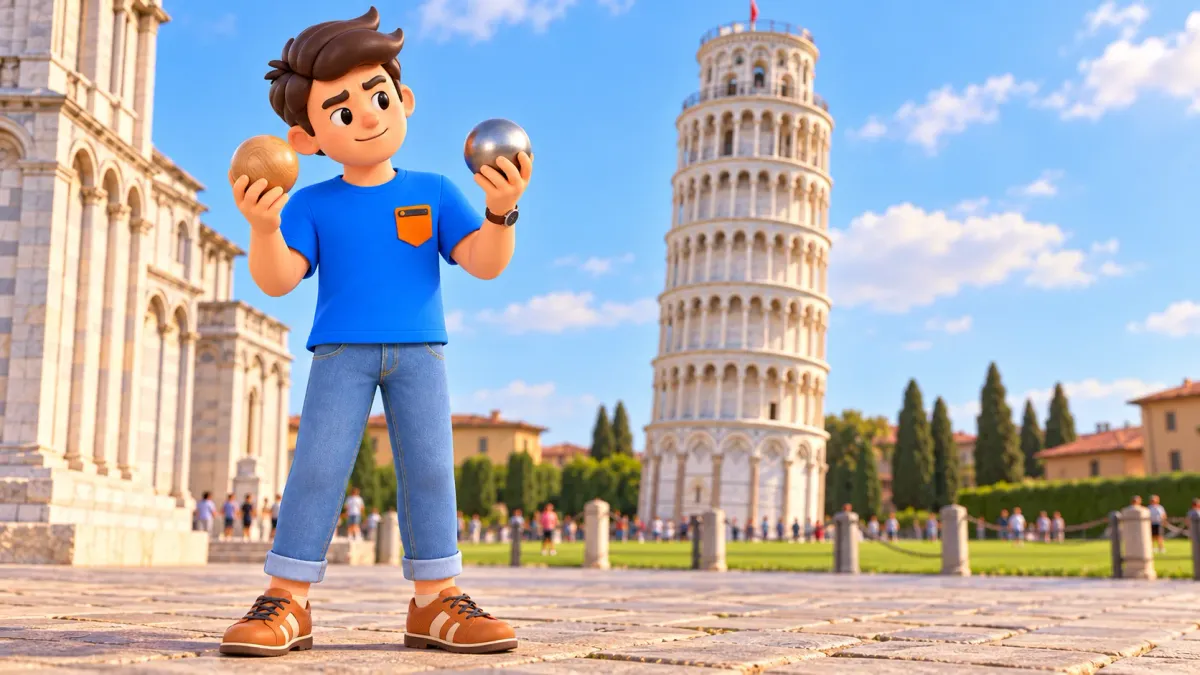
Galileo at the top of Pisa’s Leaning Tower, two unequal weights and an astonished audience below: the scene almost directs itself. Standing in the square, it is easy to remember and accept as a precise episode awaiting only its location. The history is more complicated. Galileo’s connection with Pisa is established, while details of the famous demonstration are known principally through a later biographical account. Those statements can coexist. The city remains important to science even when its most theatrical story needs care rather than treatment as a documentary frame from the sixteenth century.
Distinguish biography, a narrative of an event and later remembrance. University work belongs to the first, falling bodies to the second, monuments and images to the third. You need not choose between believing everything and feeling disappointed in the whole city. Notice how scientific history becomes an urban legend, and how that legend draws attention back to real research. This is a way to read Pisa, not a detailed route through every Galilean address or a search for the one place where the entire scientific revolution supposedly happened at once.
A real connection, a debated scene
RoadMe creates a personalised walk or whole-trip plan around your interests, available time and usual pace. Using it in the app makes connecting Pisa’s scientific history with university places, architecture and rest more convenient and effective, choosing a depth of discovery that suits you.
Galileo was born in Pisa in 1564, studied at its university and taught mathematics here from 1589 to 1592. That provides a firm starting point. The public tower demonstration has a different level of certainty: repetition does not turn it into an episode fully documented by contemporary witnesses. Caution need not mean declaring it impossible. The familiar scene and the established biography rest on different evidence. That distinction helps more than a slogan calling everything either proved or entirely invented, especially when visiting a city whose memory contains both documented relationships and enduring stories.
The real Pisa of a young scholar
The university connects Galileo with Pisa as meaningfully as the bell tower does. His studies began in a medical setting, while mathematics and motion became central interests. Later he returned as a teacher. This story contains classes, seeking a position, colleagues and ideas developing over time. It is a human biography rather than one instant of inspiration before a crowd. Imagine reading, calculation, argument and revised explanations when looking at university Pisa. That setting helps explain why falling bodies became a question worth pursuing, not simply a scene conveniently provided by an unusually shaped tower.
Palazzo della Sapienza gives an architectural image of the university city. Its courtyard and galleries belong to a long educational history; the building changed with new needs. Later images and sculptural remembrance of Galileo express recognition by subsequent generations. They do not make every room an unchanged classroom from his years. Distinguish the institution’s history from today’s appearance. The university setting becomes an experience in its own right rather than a stop justified only by saying a famous person was once here. Architecture can reveal continuity while still showing change after that person’s lifetime.
Where the tower account comes from
A key source is Vincenzo Viviani, Galileo’s late pupil and biographer. His historical account of Galileo’s life, written in 1654, describes demonstrations from the bell tower before lecturers and students. That is much later than Galileo’s teaching years in Pisa. Born in 1622, Viviani could not have witnessed events of the late sixteenth century. Knowing Galileo makes his account important without turning it into a diary written beneath the tower on the supposed day. Where the narrative comes from belongs to the story itself, not merely a specialist footnote to be ignored during a visit.
Pause the cinematic picture at this point. Two particular balls, an exact remark, every philosopher’s response and the immediate birth of a new science often belong to retelling. Later paintings and educational illustrations make the story vivid without supplying independent confirmation. An image’s popularity shows explanatory power rather than a complete historical record. At the tower, a useful formulation is that a famous account associates it with Galileo’s experiments, while the truth of that public scene remains debated. This retains the encounter without asking the place to establish more than the surviving evidence can support.
Museo Galileo materials preserve that caution. They allow the possibility of experiments without making proof of the dramatic episode necessary to recognise his work on motion. That also helps a visitor. The choice is not between enthusiastic repetition and debunking for its own sake. You can imagine a narrative and appreciate its force while remembering that imagination does not recover every detail. The square gains a history of how later centuries shaped a scientist’s image alongside the medieval bell tower’s own story. Both belong to the place, although they are not the same kind of evidence.
What this changes about the science
A commemorative inscription at the tower recalls the experiments too. Words fixed on the monument can feel like final confirmation, but a memorial text also belongs to a particular period and its way of remembering. Treat it as part of Galileo’s fame and ask when it was made. Stone makes memory visible without removing the distinction between contemporary testimony and later commemoration. This is a useful habit beyond Pisa: a plaque tells you something real about remembrance, even when it cannot resolve every question about the event it celebrates.
Behind falling bodies is a question about explaining motion and testing accepted ideas. Galileo worked through mathematics, reasoning, observation and experiments; his views developed rather than arriving complete after one public gesture. Early Pisan investigations should not automatically become all his later formulations. The tower provides a recognisable scene, the university a working setting and texts a way to follow changes. No expressive monument can contain the whole process. A visit can open that process to curiosity rather than pretend that one building replaces the long history of scientific work.
The walk need not become a test of a school formula or a verdict on every predecessor. Conditions, explanatory language and forms of argument matter alongside the familiar phrase about heavy and light objects. Motion in air is also more complex than any pair of things always landing together. Keep the larger meaning: people asked questions and changed models. One useful question is enough to take away, without assigning identical behaviour to all objects or a complete modern physics to one heroic individual. The uncertainty of an anecdote need not erase the value of those questions.
The cathedral lamp: another powerful story
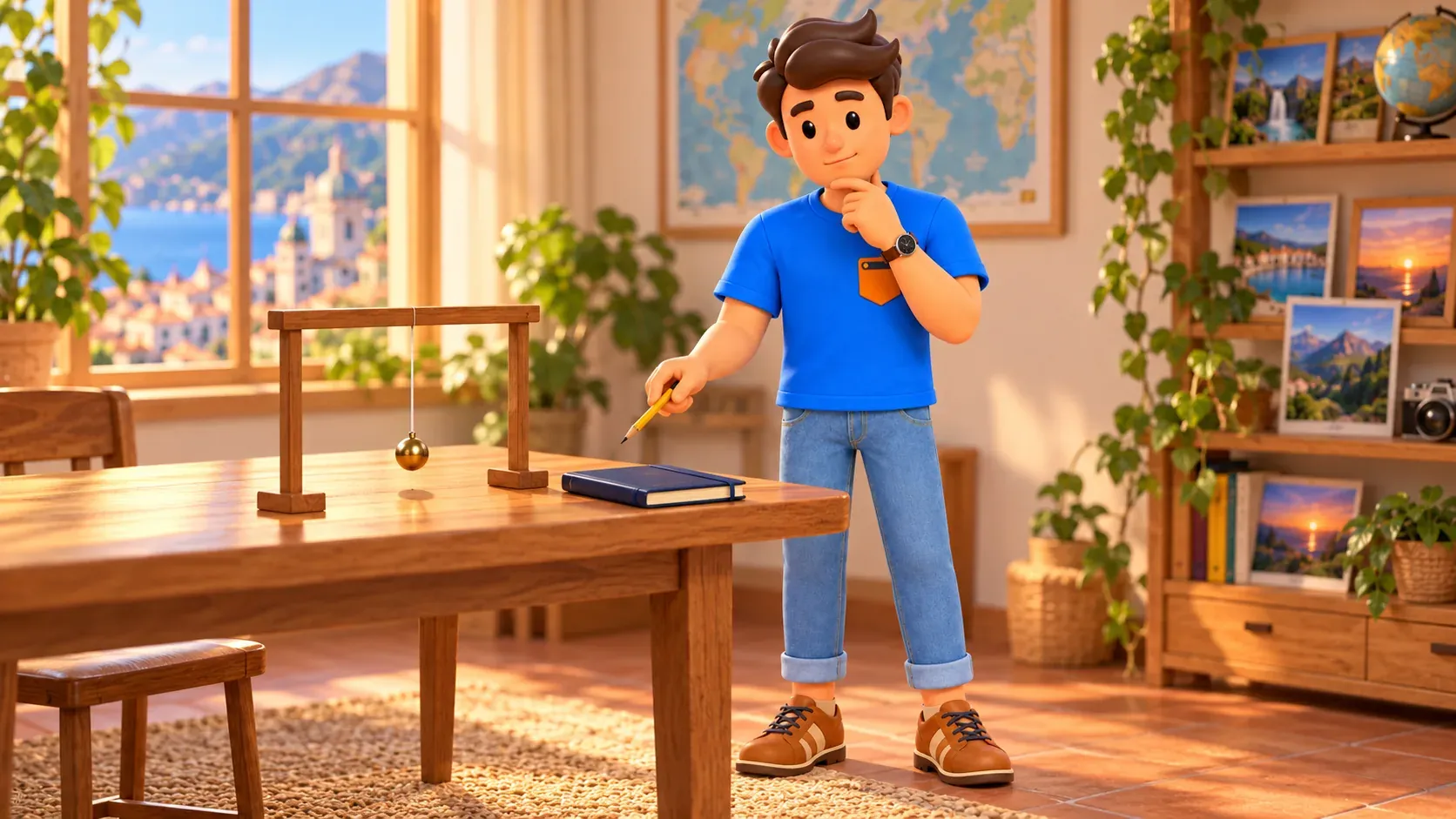
The cathedral is associated with young Galileo watching a swinging lamp and comparing its timing with his pulse. That too belongs to Viviani’s biographical tradition. Its appeal is an everyday observation becoming research. Separate that image from the particular object shown today. The cathedral’s large bronze lamp dates to 1587, later than the early student scene usually described. A familiar name does not establish a personal encounter between scientist and object. The distinction concerns the chronology of a thing, not whether the general idea of becoming curious about ordinary motion is worth remembering.
Another lamp formerly in the cathedral is preserved in the Camposanto and associated with the tradition. Its existence makes the discussion of earlier lights richer without proving exactly what Galileo watched or when. Again, distinguish object, narrative and scientific result. Museo Galileo’s chronology identifies a 1602 letter with documentary formulation of the pendulum principle. An early scene of inspiration and a later document need not collapse into one date for the sake of an easy explanation. The interval is part of a research history rather than a defect that a tour story must conceal.
Nor should the pendulum story become a universal claim that every swing always takes exactly the same time. Conditions and approximations matter, and subsequent refinements show research continuing. For a walk, the useful connection is attention to an ordinary thing becoming a question. The cathedral remains a working church and major artistic space, not scenery to be reduced to one scientific anecdote. If you enter, retain time for its architecture. The Camposanto need not become another obligation solely to inspect every object mentioned in the Galileo story. Choose the visit because its wider subject interests you too.
Remembering Galileo has a history too
Domus Galilaeana on Via Santa Maria matters as an institute studying scientific history. Its name does not make it Galileo’s ordinary house. Founded much later, its importance lies in books, archives and research. Memory is more than a statue: documents are preserved, compared and reconsidered. An exterior encounter can draw attention to this less visible city without assuming free access to research rooms or presenting a later institution as an untouched sixteenth-century interior. The building offers a subject about the continued study of science after the famous scientist’s lifetime.
Modern images offer another kind of memory. In Eduardo Kobra’s mural, Galileo holds Pisa’s tower like a telescope: an artistic combination of familiar symbols, not a reconstruction of an instrument or experiment. The statue near the citadel also belongs to later urban culture rather than Galileo’s own time. Read these as statements by following generations. Art need not behave as an event report. Ask which qualities the city chooses to represent: curiosity, observation, bold questions and an identifiable relationship with a place. The picture can be meaningful without becoming literal evidence for a historical scene.
Not every discovery belongs on one tower
Galileo left for Padua in 1592 and worked there until 1610; Florence and other places also belong to his life. His telescopic work and later career should not all move onto Pisa’s bell tower. Distinguishing cities gives the Pisan part precision rather than diminishing it: birth, study, early university teaching and later cultural memory. Pisa becomes a substantial part of a larger journey instead of the only stage for every achievement. That scale is more useful than collecting all familiar anecdotes inside the single most photogenic building available on the itinerary.
Choose a scientific subject for the walk
RoadMe develops a personalised plan for the whole trip around your interests, from science and architecture to university history or contemporary art. Keeping it in the app is more convenient and effective than joining separate addresses and repeatedly deciding how many different stories will fit your day without rushing.
Choose one emphasis. At the tower, consider how a famous account takes shape; in the university district, the actual setting of study and teaching; before a modern image, the ways a city remembers. This is not a compulsory sequence. Interior access and journeys depend on your chosen programme. The main benefit needs no complete list: enjoy a legend while understanding its status. Galileo then returns from a ready-made picture to a human history that asks for curiosity, time and attention to what supports each story told about a place.
Explore further: our Galileo and scientific Pisa walk.


