
First Flight With a Baby: Airline Checks and Preparation
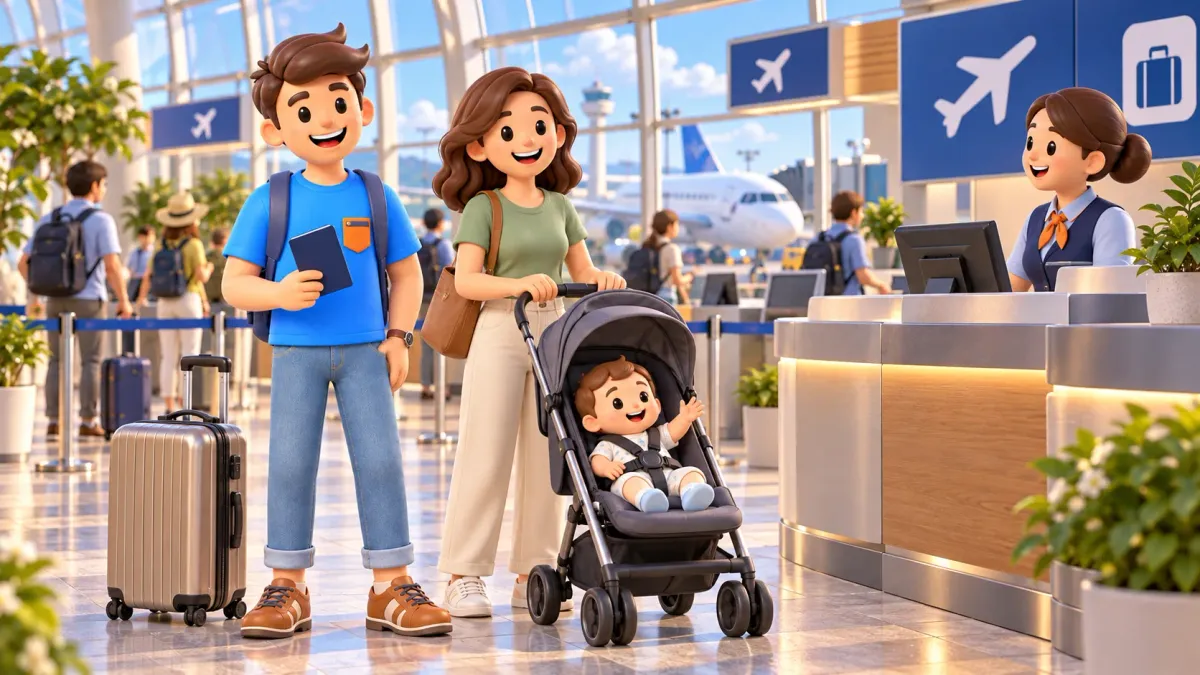
Before booking your baby’s first flight, check the operating airline’s minimum age, seating options and documents for the complete journey. Then confirm stroller and child-seat arrangements, feeding supplies at security and what you need in the cabin. Check every flight, including the return: one carrier’s conditions do not automatically apply to another.
This guide helps you organise an infant’s first flight. Airline acceptance and your baby’s readiness to travel are separate questions; individual health advice comes from their paediatrician.
Check age requirements and discuss health first
Ask the airline about minimum age, any medical certificate and the required format. Do not treat somebody else’s “allowed from this day” rule as applying to your booking. Travel soon after birth also needs to take the accompanying adult’s recovery into account.
Discuss flying with the paediatrician, especially for a newborn, heart or lung conditions, respiratory symptoms, a recent ear infection or ear surgery. Ask what could change the decision to travel, which prescribed supplies to take and where to obtain care after arrival. Do not independently use medication to make your baby sleep on the plane.
Compare the whole journey
Include travel to the airport, check-in, waiting, the flight, any connection and the journey to accommodation. A nonstop flight reduces transfers and boarding procedures, but also consider when you must leave home and whether you can access your room after arrival. A night flight does not guarantee sleep for either parent or baby.
For a connection, establish whether you collect baggage, pass immigration and check in again, and where the stroller will be available. Do not select a short gap based only on the search result. Read how self-transfers differ from connecting flights for the practical checks.
For the city part of your trip, try outlining relaxed day-by-day visits in RoadMe and removing unnecessary stops after arrival. Check stroller access directly with the places you choose.
Confirm the ticket, seat and bassinet separately
Include your infant in the booking and obtain their ticket even when they will travel on your lap. Compare the full lap-infant and separate-seat prices, including taxes, fees and adult seat selection. If your child crosses the fare’s age boundary during the trip, ask how the return must be booked.
Consider an individual seat with a suitable approved child restraint. For U.S. aircraft, the FAA recommends an approved restraint in the child’s own seat for under-twos: arms cannot securely hold a lap infant during unexpected turbulence. Confirm your carrier’s accepted model, labels, dimensions, installation and seat position. An ordinary car seat is not automatically approved for flying.
A bassinet is a separate facility depending on aircraft, seat location and your baby’s size. Ask about age, height and weight limits, the request deadline and whether availability is confirmed or conditional. Prepare for it to be unavailable. It does not replace the carrier’s restraint instructions for take-off, landing or turbulence.
If another adult is travelling with you, confirm neighbouring seats and any selection charge. With more than one infant, establish the number allowed per accompanying adult and which children need separate seats. Check the actual operating carrier, including partner flights.
Check the baby’s documents for each border
Match the name and birth date in the booking to the original document. Separately establish proof of identity and age for the airline, and entry, exit, visa and transit requirements for your child’s nationality. A document sufficient for a domestic flight may not meet international travel requirements.
When travelling with one parent or another accompanying adult, check any consent, relationship evidence and additional paperwork for each country involved. Living together or sharing a surname does not establish the required documents. Obtain the relevant information from the authorities and confirm the airline’s document procedure before paying.
Agree on baby equipment and pack accessible supplies
Measure the stroller when folded and record its weight. Ask whether you may use it until boarding, where to hand it over and whether collection is at the aircraft or in baggage reclaim. Arrival procedures can vary by airport. Use a suitable cover, remove loose accessories and keep the baggage tag.
Check your infant’s cabin and checked-baggage allowance, plus the child seat as a separate item. Fare type and whether the baby has their own seat can change the allowance. Free carriage of a stroller does not establish that every model is accepted in the cabin.
| Cabin supplies | Preparation |
|---|---|
| Documents | Keep originals and confirmations accessible |
| Feeding | Usual supplies and a preparation plan for the whole journey |
| Changes | Nappies, wipes, mat, spare clothing and bags |
| Prescribed supplies | Clinical instructions and checked transport conditions |
| Delay reserve | Extra essentials available before collecting luggage |
Base supplies on more than the scheduled flight duration. Arrange the bag so a change does not require emptying everything. If two adults are travelling, agree who handles the documents, bags and baby at each stage. When travelling alone, ask what airport help exists without assuming a childcare service is included.

Check feeding supplies at security and plan boarding
Confirm rules for breast milk, formula, water and cooling packs with the airport or screening authority at every relevant point. Baby-feeding supplies may have different conditions from ordinary liquids. Airline permission does not replace security screening; check packaging, quantity, presentation and any additional inspection.
For example, UK airport guidance allows sufficient baby food, milk and sterilised water for the journey when travelling with a baby, with product-specific conditions and screening. It also distinguishes liquid breast milk from frozen breast milk. Check the exact supplies you plan to carry rather than assuming every form of milk has the same permission. Other countries have their own rules.
Keep supplies accessible for inspection. Choose preparation and storage arrangements according to product instructions and clinical advice. Do not depend on the crew providing a particular water supply, temperature or equipment unless confirmed beforehand.
Check check-in and boarding deadlines, airport changing facilities and whether family boarding is offered. Follow crew instructions for installation and restraints. A carrier used while walking through the airport and a bassinet are not automatically substitutes for approved restraint arrangements throughout the flight.
Arrange arrival and complete the final checks
Confirm stroller collection, transport to accommodation and an appropriate child seat for any car journey. Tell the property your expected arrival time and arrange the baby’s sleeping space in advance. Leave room to rest after travelling.
Before flying, download the city in RoadMe while online and check the offline map for later walks. Keep tickets, the accommodation address and airline confirmations separately.
Final checks: your baby is in the booking, personal documents fit the route, seat and equipment conditions are confirmed, feeding supplies meet the relevant screening rules, and essentials remain accessible in the cabin. Treat an unconfirmed bassinet or stroller return as an unresolved condition and prepare a workable alternative.


