Amsterdam with kids: a day built around one discovery
A family day in Amsterdam is easier to enjoy when it has one main discovery. Instead of collecting five compulsory attractions, let a child leave with a question they have tried to answer: what changes a movement, how does a reflection work, or what can water make happen? NEMO Science Museum at Oosterdok gives that approach a useful home. Visitors can try, compare and return to an interesting experiment. The adult’s task is to leave room for those attempts, rather than lead the family through every floor in a single visit.
Our example runs approximately 10:00–14:30: three hours at NEMO, forty-five minutes for your own lunch, thirty minutes beside the water and fifteen minutes to rest. Start at the museum entrance, Oosterdok 2, and finish on a suitable public section of the nearby waterfront. Travel from your accommodation and the journey back are extra. The suggested rhythm is particularly useful to consider for children around six to twelve who enjoy trying things themselves. That is an editorial guide, not the museum’s age restriction or a promise that every child will want exactly three hours inside.
Choose an interest before choosing more stops
Before travelling, ask what sounds interesting: light and bubbles, movement and machines, or water doing useful work. There is no need to teach the correct answer beforehand. Choose a question you can revisit that evening. It gives the day a purpose the youngest participant can understand. With several children, let each choose a question. Their interests do not have to match, and observing somebody else’s experiment can also be rewarding. Agreeing on a theme is usually easier than negotiating a compulsory number of rooms everyone must complete together.
Try RoadMe for a complete personalised route or trip plan shaped around your family’s interests and pace. The app makes it much easier to connect the day’s main discovery with a walk and useful breaks in one considered programme.
Explain that the museum is the main event, followed by food and a short walk. That removes the constant question of which major attraction comes next. Give children real choices within that structure: which experiment to try, whether to repeat it and what to show an adult. Parents keep responsibility for the practical arrangements. This need not turn a holiday into a lesson. It simply gives a child an active role, instead of making them a passenger moved between places somebody else has decided must appear in the family’s photographs.
Check the date, ticket and age conditions
NEMO’s ordinary opening hours are Tuesday–Sunday 10:00–17:30. Monday opening depends on the calendar, so check your actual date. Special holidays can also have different hours. Our ten o’clock start means an ordinary open day and a suitable ticket time, rather than every possible day of the year. Tickets have a start time; booking ahead is the convenient option. Tickets sold at the museum depend on remaining availability. Avoid building the morning around an assumption that the ticket desk will certainly have the places your whole family wants.
Ordinary admission is paid from age four, while children aged zero to three enter free. Include everyone under the appropriate categories when booking and check any pass conditions individually. An accompanying parent does not automatically receive free admission. For an accurate family budget, consult the current ticket tariff and add lunch and travel separately. A city pass is not automatically good value for one museum visit. The useful decision here is how to arrange the day you actually want, rather than buying a larger collection of benefits because it appears to offer more possibilities.
Children under thirteen must visit with an adult. NEMO welcomes different ages, but some activities are for visitors aged six and over. A photograph of a laboratory therefore does not mean every preschool child can join that particular activity. This plan does not depend on a specific workshop, a laboratory place or a demonstration at a fixed minute. Fenomena and Technium provide its main framework. Check the current programme and conditions important to your family, while leaving the detailed order flexible enough to respond to what attracts attention after you arrive.
10:00: begin with the building and a gentle arrival
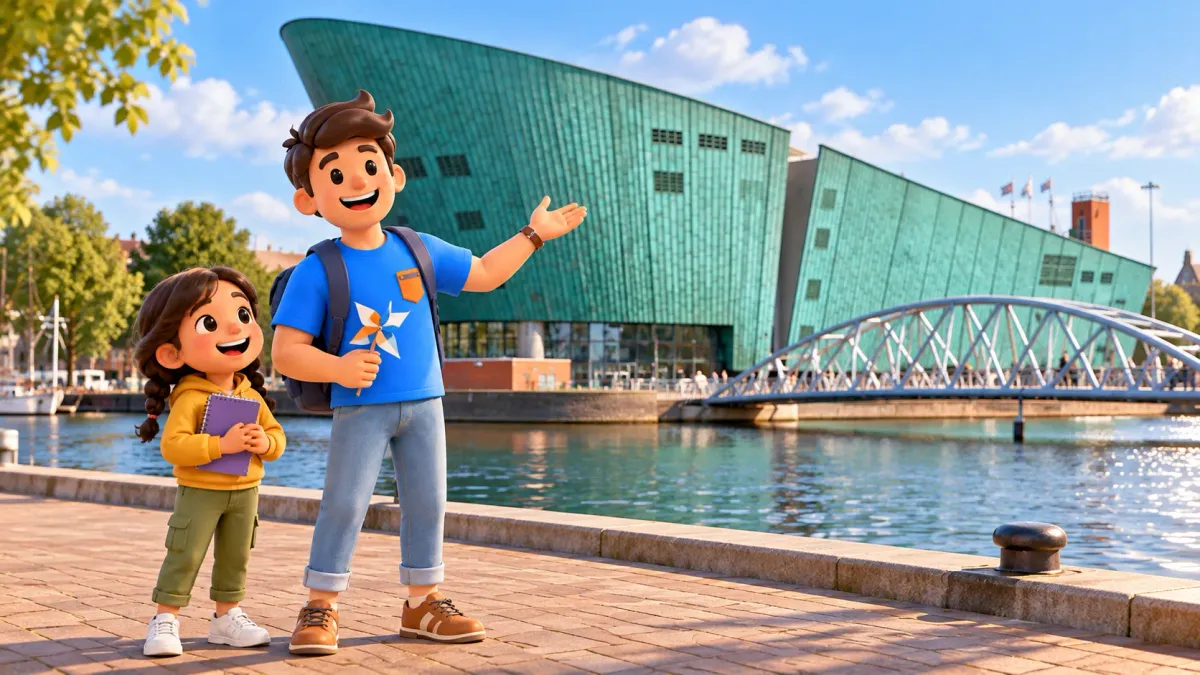
Allow twenty minutes for entering and finding your bearings. Outside, invite a child to compare NEMO’s green form with something familiar. It may suggest a ship, but it is not an actual ship converted into a museum. Renzo Piano designed the building above the IJtunnel, whose curvature helped shape the architecture. The present building opened in 1997 as NewMetropolis, a name later replaced by NEMO. This short piece of history connects directly to something visible, without asking children to stand through a long account before reaching the entrance.
Inside, sort out practical needs and choose an initial direction. There is no need to race to the busiest installation. If a child wants to watch first, let them: observing others can help make an unfamiliar activity understandable. Choose something manageable and read the available instructions together. Even if the principle is familiar, an adult can pause before demonstrating the result. The first independent action sets the tone. The twenty-minute allowance is flexible, so redistribute it if getting organised takes a little less or more time than expected.
Fenomena: one question, several attempts
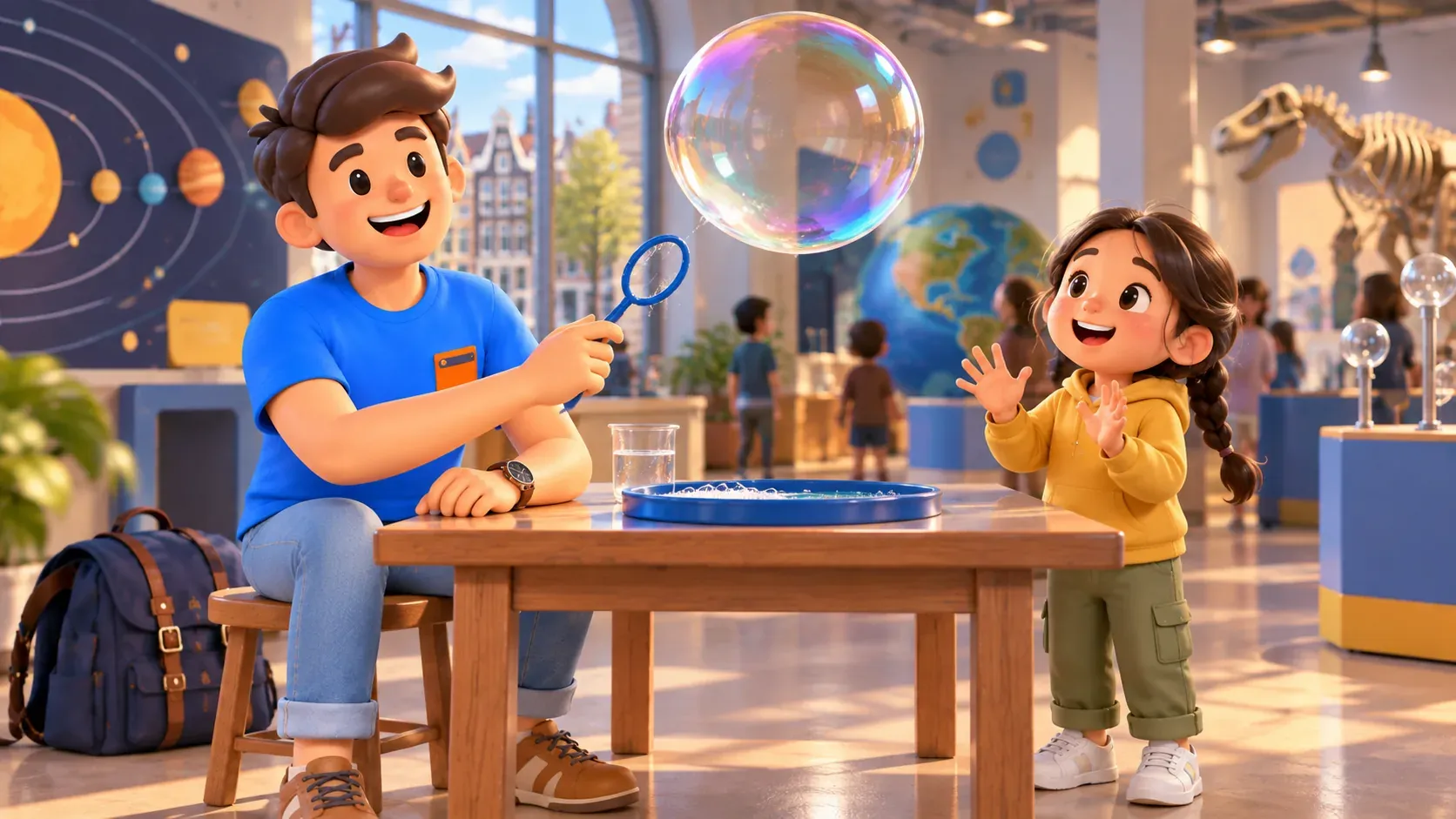
Spend approximately 10:20–11:20 in Fenomena on Floor 1. This area explores everyday physical phenomena, including light, sound and static electricity. The museum describes examples such as large soap bubbles, a spinning chair and pulley devices. Choose an available activity according to interest and the instructions on site, rather than expecting to complete every installation. A satisfying discovery can come from just one situation in which a child predicts something, tries it and notices that the result differs from the expectation. That is already enough substance for a memorable morning.
Instead of asking whether they understood, ask what might change if they tried differently. Let the explanation come in ordinary words. Afterwards, ask what they actually noticed, rather than which formula they remember. An incorrect prediction gives you something to compare; it does not make the attempt a failure. If there is a queue, choose something else or return later. Do not promise immediate access to a particular exhibit. Interest is easier to maintain when the visit offers choices than when everyone waits solely to reproduce a photograph from somebody else’s account.
A break, then everyday technology
Pause around 11:20–11:30. Water, a sit-down where available or simply stepping back from new impressions may help more than immediately moving upstairs. NEMO permits your own food and drink in designated areas, so use those rather than eating among installations. If you need a shorter visit, adjust now. Three hours is our suggested allocation, not a compulsory ticket duration. Ordinary visitors may stay longer, until closing if they wish. That freedom is useful, but it does not create an obligation to use every remaining hour simply because you have paid to enter.
Between 11:30 and 12:30, switch to Technium on Floor 2. Its subject is human-made technology, including familiar everyday things. The museum describes mechanisms moving tennis balls and Water Power activities among the examples. Choose one direction. With a machine, ask what begins moving first and what carries the action onwards. Water offers a connection with the city outside: Amsterdam needs practical solutions for managing it as well as attractive bridges. You do not have to turn that connection into a lecture. One observation can give the later waterfront walk a different meaning.

Let a child repeat something they enjoy. To an adult, repetition may look like wasted time, but a second attempt creates the opportunity for a deliberate comparison. Avoid taking over, insisting on a neat conclusion or promising an identical result. If the subject does not appeal, try another available part while keeping the day’s broad question. The family still has choices. A museum plan helps you manage the number of possibilities without becoming overwhelmed; it should not hold an uninterested child at a preselected device purely to prove the original plan was correct.
12:30: return to a favourite before leaving
Use the final half-hour, until about 13:00, for a favourite activity, a short conversation and leaving. Ask what the child would show somebody who had never visited. That choice often expresses the experience better than counting completed areas. The rooftop, laboratory and separate demonstrations are not compulsory extensions of this plan. If adding one, reconsider your available time and its current conditions. Do not append another large block merely because admission has already been paid and leaving without seeing everything feels like failing to obtain the full value of the ticket.
Lunch and a short Oosterdok walk
Set aside 13:00–13:45 for your own lunch. Choose something suitable for your budget and family beforehand, without relying on a guaranteed empty table at a particular café. With your own food, use a permitted place and consider the weather. This is a real break, not eating while hurrying towards another museum. A child might enjoy drawing a remembered machine, but lunch does not have to continue the lesson. Sometimes a quiet meal and an unrelated conversation are exactly what everyone needs. Rest deserves a proper place in a successful family itinerary.
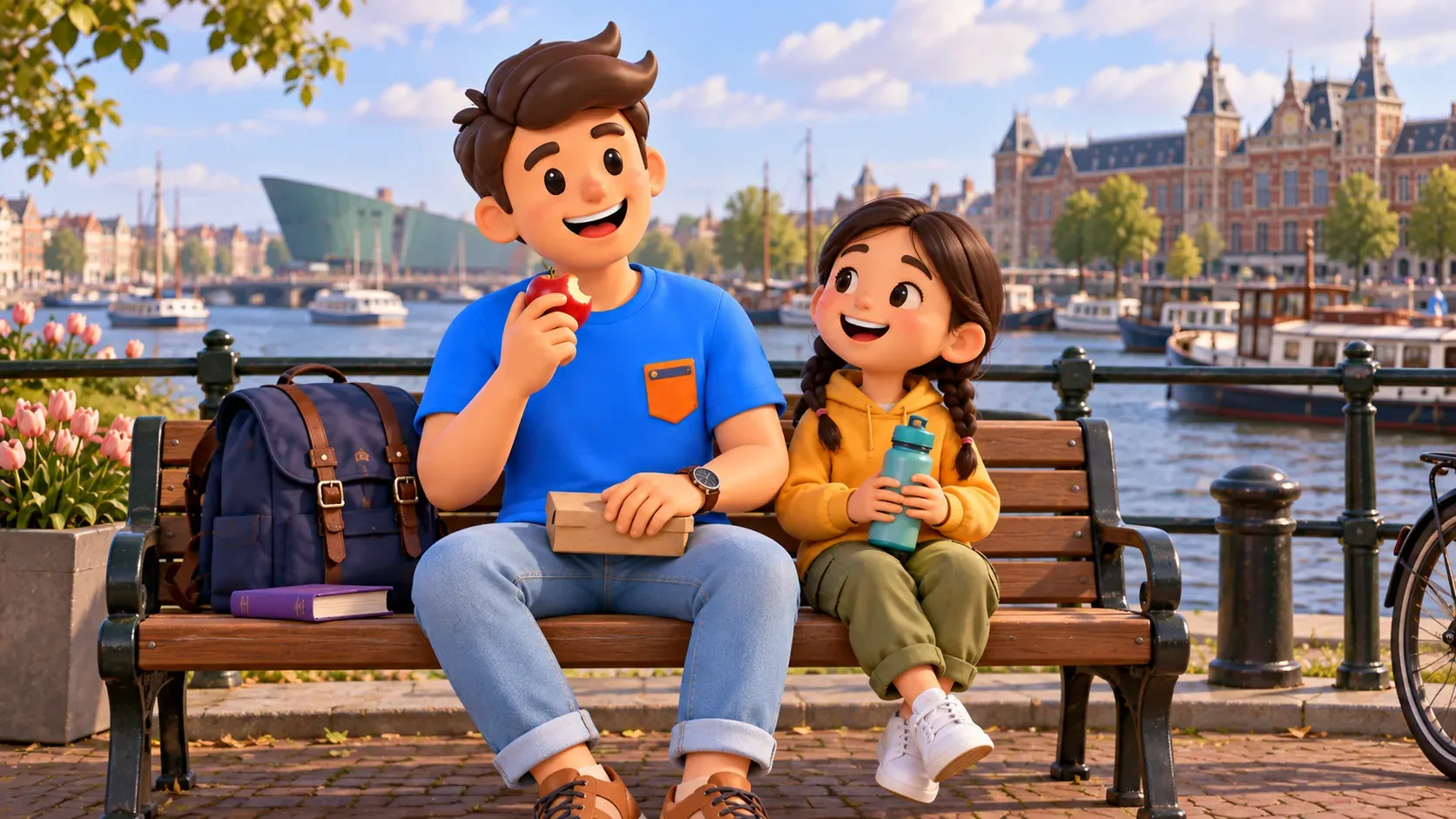
From 13:45 to 14:15, explore an available public stretch of Oosterdok waterfront nearby. Use the current safe pedestrian route, leave space for cyclists and remain well back from the water’s edge. This is not a long transfer to another ticketed attraction. Look at boats, reflections and the returning silhouette of NEMO. See whether one connection with the morning’s question emerges: movement, a material, water or light. If the child has had enough tasks, simply walk. Save the more detailed Oosterdok itinerary for another day rather than attaching the entire route to this museum visit.
Finish around 14:30 with energy left
Keep the last fifteen minutes for resting and organising your return somewhere suitable nearby. Travel to accommodation or onward transport is additional to the four-and-a-half-hour programme. In strong wind or rain, omit the waterfront section and finish after lunch. For younger children or anyone who tires quickly in a stimulating environment, shorten the museum allocation first. For an enthusiastic school-age visitor, allow longer with one theme. The same broad sequence does not require identical timings for every family. Its purpose is to support the people taking part, rather than make everyone fit one idealised version of the day.
For the whole trip, try a personalised plan in RoadMe that reflects your family’s interests and preferred pace. It is a more convenient way to organise the main discoveries and rest across your days, with a comfortable continuation after a museum morning.
The day’s best result might be small: a child tested an idea, noticed a difference and wanted to tell someone that evening. You do not need every NEMO floor or every Amsterdam landmark for that. Before leaving, check the ticket date and start time, conditions for chosen activities and your approach to the museum. Then allow the things you cannot schedule precisely: curiosity, a second attempt, a funny observation and a timely pause. A clear structure with some freedom gives the family a discovery of its own, rather than a copy of another traveller’s checklist.